
How Video Investigator® 64 Strengthens Forensic Video Analysis
Quick Summary:
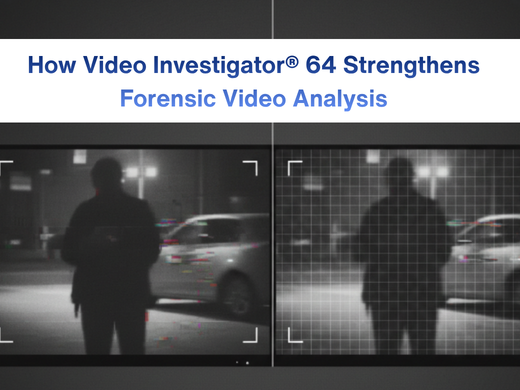
The article demonstrates Video Investigator® 64 capabilities for forensic video analysis through its frame-adaptive enhancement feature and advanced deblurring tool and synchronized playback function and tracking tools and automated redaction system. The platform provides professional video enhancement capabilities to investigators and legal professionals who require these tools for their work.
The Growing Demand for Reliable Video Evidence
Digital recordings are essential components of contemporary investigations. Critical incidents occur daily which surveillance cameras and body-worn devices and dashcams and mobile phones document. The footage investigators receive contains motion blur and compression artifacts and low lighting and limited resolution which impair its quality. The technical limitations of the system lead to crucial visual details being hidden from view.
Forensic video analysis requires visual improvement, but it requires more. The process requires structured workflows that allow for reproducibility and all processing steps to be documented. Investigators need to verify that their enhancements keep the original content intact while they need to maintain records of all adjustments made. The essential role of professional video enhancing software becomes evident in investigative settings.
Video Investigator® 64 functions as forensic video analysis software inside dedicated forensic workflows which prevent its use in unstructured editing tasks.
Core Capabilities That Support Investigations
The platform combines advanced tools into a complete forensic environment. The new capabilities improve both analytical precision and evidentiary transparency.
1. Frame-Adaptive Enhancement
The system allows different processing parameters to be applied to individual frames or selected regions instead of applying global corrections across the entire video.
2. Advanced Deblurring Techniques
The system applies adaptive blind deconvolution and motion deblur filters to reduce camera shake and subject movement-induced blur.
3. Noise and Artifact Reduction
The system uses edge-preserving algorithms to eliminate compression artifacts and digital noise while maintaining structural integrity of the content.
4. Precise Region Selection Tools
The system provides glyph-based selections which enable users to choose points and lines and polygons to create specific enhancement areas.
5. Object Tracking and Motion Assessment
The system enables users to track subjects or vehicles frame by frame for movement reconstruction and velocity estimation purposes.
6. Multi-Source Synchronization
The system enables users to align multiple video streams for timeline reconstruction purposes and cross-camera comparison activities.
6. Automated Redaction
The system uses tracking-based masking to block out sensitive elements which preserves all original content.
8. Audit Logging and Script Replay
The system records each processing step to provide reproducible results which maintain courtroom-defensible evidence.
The system possesses these features which enable it to function as specialized video enhancing software designed specifically for investigative environments
Structured Workflow for Forensic Review
Investigators start their work by securing original media files through hashing. The platform processes verified working copies which users create. Forensic video analysis requires analysts to perform the following tasks:
- Identify frames containing relevant activity.
- Apply targeted enhancement to degraded areas.
- Track subjects across time where movement analysis is required.
- Synchronize additional camera sources if available.
- Export annotated frames or enhanced clips for reporting.
The controlled video enhancing software system allows users to create processing records which they can use to replay the entire system. Technical validation of findings becomes possible through this level of transparency which establishes a genuine record of all technical validation procedures.
Why Frame-Level Precision Matters
Video degradation affects each frame with different levels of impact. A stationary background stays sharp while moving subjects look blurred. Global filters should not be applied because they might worsen the condition of already clear areas.
Frame-adaptive correction enables accurate forensic video analysis because it protects vital parts of the video. Analysts improve specific areas while maintaining whole video integrity. Professional video enhancing software uses selective processing which differentiates it from standard editing applications.

Legal Considerations in Digital Evidence Processing
Courtrooms need to see how digital evidence enhancements evolve through their entire process. Investigators need to show that they executed their investigation through controlled processes which they could repeat using scientific practices. Forensic video analysis therefore depends on tools that emphasize:
- Preservation of original data
- Parameter-based enhancement
- Detailed documentation
- Clear differentiation between original and processed outputs
Professional video enhancing software needs to maintain evidentiary standards through its log system and replay able workflow features.
Enhancing Reliability Without Altering Reality
Forensic video analysis aims to achieve more than just cosmetic improvements. The process retrieves essential visual content while upholding the original content of visual elements. Professional systems of video enhancement let analysts fix motion blur and artifacts while extracting crucial details without causing false distortions to the visual content.
The balance between clarity and integrity matters most for investigations because it affects their credibility.
Conclusion
Digital recordings have become essential tools for modern investigations because investigators need them to solve cases. Effective forensic video analysis requires both precision and transparency and reproducibility which should not be confused with aesthetic editing work.
Video Investigator® 64 functions as specialized video enhancing software which combines frame-adaptive correction and advanced deblurring and object tracking and synchronization and audit-ready documentation into a forensic environment. The platform lets investigators turn degraded recordings into clearer evidence which they can present at technical evaluations and court hearings through its forensic video analysis system.
Elevate Your Forensic Video Capabilities
Talk with experts for Forensic video Processing Software and Forensic Image Processing Software solutions. Contact Cognitech! We hope you enjoyed this Blog! Stay tuned, and don’t miss the coming blogs. You can follow us on Twitter, Facebook, Instagram, Linkedin, or Youtube: we post Community Blogs regularly so you won’t miss any!
FAQs
- What is forensic video analysis?
Forensic video analysis uses established methods to analyze and improve video evidence through systematic procedures which create documented results for both police investigations and court proceedings. - How does video enhancing software differ from standard editing tools?
Video enhancing software functions as an evidentiary workflow tool because it maintains original content while users can track all processing stages which ensures authentic results through this method. - Can degraded surveillance footage be clarified effectively?
Yes. Forensic video analysis enables professionals to reduce motion blur and compression artifacts and noise through specialized techniques which require controlled enhancement procedures. - Why is frame-adaptive processing important in investigations?
Frame-level control enables analysts to enhance specific damaged areas while maintaining the quality of unblemished regions which results in better accuracy and complete scene preservation. - Is enhanced video evidence admissible in court?
Enhanced footage meets legal evidence requirements for court evaluation when it undergoes processing through certified video enhancing software which handles documented workflows while maintaining original video content.