
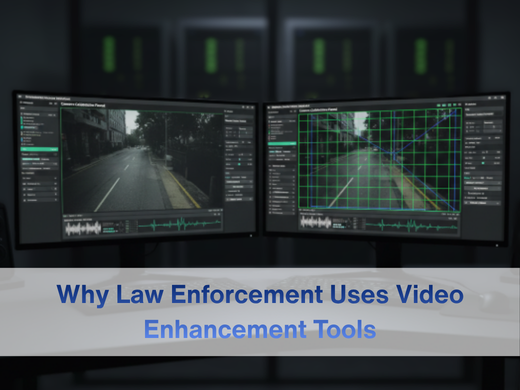
Why Law Enforcement Uses Video Enhancement Tools
Law enforcement teams often rely on video footage to solve crimes. But security camera and body cam and smartphone video footage does not always provide clear images. The videos can show either blurry content or dark scenes or shaky movements. Video enhancement software becomes essential at this point. The police use these tools to discover case crucial details which they require for their investigations.
What Is Video Enhancement Software?
The software for video enhancement enables users to enhance videos which have poor visual quality. The software provides three functions which enhance video content through image sharpening and scene brightness enhancement and noise reduction. The enhanced video material enables viewers to better identify license plates and faces and the actions which appear in the footage.
Cognitech software, called Video Investigator, is a top choice for this kind of work. The program has gained worldwide acceptance by law enforcement agencies and forensic investigators as their preferred solution.
Why Blurry Videos Are a Problem
Many times, videos recorded at a crime scene are blurry. The camera and the subject both create motion which leads to blurriness in the footage. Blurriness occurs when fog or glass or insufficient lighting conditions are present.
Video deblurring software provides essential support for forensic investigations. The deblurring tools can remove various types of blurs which include:
- Motion blur occurs when the subject or camera moves.
- Defocus blur occurs when the camera mechanism loses its focal point.
- Optical blur refers to distortion which happens when camera lenses are used.
- Atmospheric blur happens when fog or haze exists in the environment.
- Gaussian blur represents a standard type of soft blur which occurs in nature.
The software provides multiple filters to solve various issues through Cognitech Video Investigator. The software system can develop a specific solution which matches the particular video blur type.
One Tool for Many Jobs
Video Investigator serves multiple functions beyond video deblurring. It includes all essential instruments required by forensic teams for their investigations:
- Image enhancement software to clean up photos or single frames
- The system enhances video resolution so that even small details become visible.
- The system uses real-time processing to improve fieldwork efficiency.
- Photogrammetry tools to measure objects or distances in video
The integrated software solution enables users to complete their tasks more efficiently. The system allows investigators to perform all necessary tasks from a single platform.
Real-World Impact
Enhanced video technology enables police officers to identify suspects while locating missing persons and demonstrating criminal activities. The most compelling court evidence frequently occurs when clear video footage exists.
Law enforcement agencies maintain their investment in Cognitech video enhancement software because of its proven ability to deliver accurate visual results. The software system delivers transparent visual results which establish accurate truth and bring about community justice.
Adding Depth with Camera Calibration and Lens Correction
The Video Investigator system provides users with tools for improving footage visibility and removing blurriness. The system requires operational capabilities which Camera Calibration and lens correction provide.
Cognitech Video Active 64 operates as a forensic instrument which supports enhancement workflows through its advanced preprocessing functions. The system delivers reliable Camera Calibration capabilities which enable users to correct intrinsic camera errors prior to enhancing visual content. The system ensures that measurements and angles and derived data maintain their accuracy throughout the process.
Security cameras which are inexpensive experience optical distortion problems due to their low-cost lens systems. The resulting distortion creates errors when the recording needs precise identification or measurement. Forensic operations require lens correction to function properly. Lens correction allows analysts to assess the scene with better precision because it eliminates fisheye effects and barrel distortion and unwanted warping.
The software uses Camera Calibration to detect internal camera attributes which include focal length and optical center to generate precise geometric calculations. This function proves vital for environments where multiple cameras operate simultaneously and for tasks which need distance or size measurements or trajectory tracking.
Lens correction eliminates the visual distortions which hide essential information from view. Many surveillance systems use wide-angle lenses to monitor large areas. This design causes barrel distortion which makes straight lines appear as curved edges. Lens correction operates before enhancement processes start. The process ensures that both Video Investigator and Video Active 64 produce enhanced images which maintain their clarity and correct geometrical dimensions.
The bulk of enhancement filters get applied after the completion of Camera Calibration and lens correction processes in standard forensic video analysis workflows. The process establishes a reliable base which supports further processing operations that include deblurring and contrast adjustment and region-based enhancement.
Investigators most frequently combine calibration and correction operations before applying enhancement filters which are specialized for particular video enhancement software applications. The preparation phase of work supports analysis accuracy by minimizing measurement errors when analyzing scene reconstruction data and camera positioning data.
A Seamless Workflow for Forensic Teams
Forensic suites need to go through structural analysis of a video file which includes conducting metadata extraction and image integrity verification. The system uses Camera Calibration to fix camera-specific distortion while lens correction eliminates image distortion through its geometric normalization feature.
The investigators start their analysis by using video enhancement software after they complete the preprocessing phase. Advanced filters reduce noise, improve resolution, and clarify features that were previously indiscernible. The video deblurring software restores lost detail which occurred during both fast motion and low focus situations.
The workflow order of calibration, correction, enhancement, and review enables investigators to access the most precise data available.
Conclusion
The current era has widespread video usage, yet certain videos do not provide sufficient clarity for proper evaluation. Law enforcement agencies use video enhancement tools to improve blurred and chaotic footage into clear evidence that they can use. The process of creating clear footage begins with proper capture techniques, which makes Camera Calibration and lens correction preprocessing steps essential for filmmakers.
The complete forensic workflow for geometry accuracy and clear image detail evaluation is supported by Cognitech Intelligence and Video Active 64, which provide complete tool sets for both forensic processes. Investigative teams achieve reliable and court-defensible visual evidence through robust enhancement methods that need precise calibration and correction processes.
Enhance Your Forensic Video Evidence Today
Talk with experts for Forensic video Processing Software and Forensic Image Processing Software solutions. Contact Cognitech! We hope you enjoyed this Blog! Stay tuned, and don’t miss the coming blogs. You can follow us on Twitter, Facebook, Instagram, Linkedin, or Youtube: we post Community Blogs regularly so you won’t miss any!
FAQs
- What is the purpose of video enhancement software in criminal investigations?
Law enforcement agencies utilize video enhancement software to enhance video recordings which helps them identify facial features and vehicle registration numbers and particular behaviors which remain undetectable in unprocessed and blurred and dark video footage. The technology enables law enforcement to identify crucial evidence which assists criminal investigations and courtroom presentations through its ability to detect minute details in difficult to see areas. - What benefits does video deblurring software provide to forensic investigators?
Video deblurring software removes all forms of blur which result from camera movement and focus errors and insufficient lighting conditions. Forensic experts utilize the tool to enhance video content through which they retrieve crucial visual information that helps them identify suspects and objects and significant events within the crucial footage. - Why do forensic video analysis need camera calibration and lens correction as essential components?
Camera calibration establishes accurate camera internal settings which include focal length and optical center measurements. Lens correction eliminates all visual distortions which result from camera lens usage. The combination of these two processes ensures that all measurements and angles and scene geometry remain precise until the process of enhancement begins. - Can Video Investigator 64 handle multiple types of surveillance footage?
Yes. The system supports multiple video formats including CCTV recordings and body cam footage and dashcam videos and compressed digital formats. The system provides video enhancement software and video deblurring software and camera calibration and lens correction tools which enable forensic investigators to conduct detailed analysis during their complex investigations. - Is enhanced video from Cognitech software court-admissible?
The answer is yes. The forensic tools from Cognitech operate under established scientific procedures which maintain evidence integrity through their structured workflows. The system enables tracking of every enhancement process which creates transparent documentation that ensures the video content maintains its evidential value for court proceedings.