
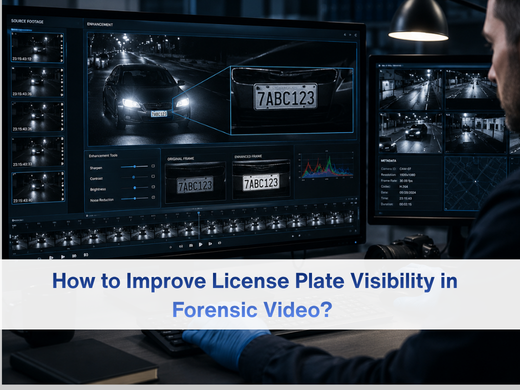
A license plate is often the single detail that turns into a case. It links a vehicle to a suspect, a timeline, and a location. And it’s almost always caught on camera at the worst possible moment too far away, too dark, too blurred, moving too fast for the sensor to keep up. This is where license plate enhancement comes in: the process of using forensic video analysis software to recover as much real detail as possible from that plate, without inventing anything that wasn’t actually captured.
It sounds simple. It isn’t. And understanding how the process actually works and where its limits are matters just as much as the final image, especially if that image is heading to court.
Why Are License Plates So Hard to Read on Camera?
Most surveillance systems aren’t built with license plate capture in mind. They’re built to cover a wide area for general monitoring, which means individual details get sacrificed.
A few things typically work against plate visibility:
- Distance and resolution: A plate that’s 40 feet from the camera might only occupy a handful of pixels. There’s a hard limit to how much detail a sensor can record at that distance.
- Motion blurred: A vehicle moving at even moderate speed can smear across several frames, especially in low light where the camera compensates with a slower shutter.
- Poor lighting: Nighttime footage, glare from headlights, or heavy shadows can wash out or obscure the characters entirely.
- Compression artifacts: Most surveillance systems compress footage heavily to save storage. That compression discards fine detail — often the exact detail an analyst needs.
- Camera angle: A plate viewed at a steep angle is geometrically distorted, which adds another layer of difficulty on top of everything else.
Any one of these problems is manageable. Several of them stacked together, which is common in real-world footage, is what makes plate recovery genuinely difficult work.
What Forensic License Plate Enhancement Actually Does?
A common misperception, often reinforced by television, is that enhancement software can zoom into a blurry image and produce a crisp, readable plate out of nowhere. That’s not how it works, and any process that claims to do this should be treated with suspicion in a forensic context. Legitimate enhancement works with the information that’s actually present in the footage. That includes:
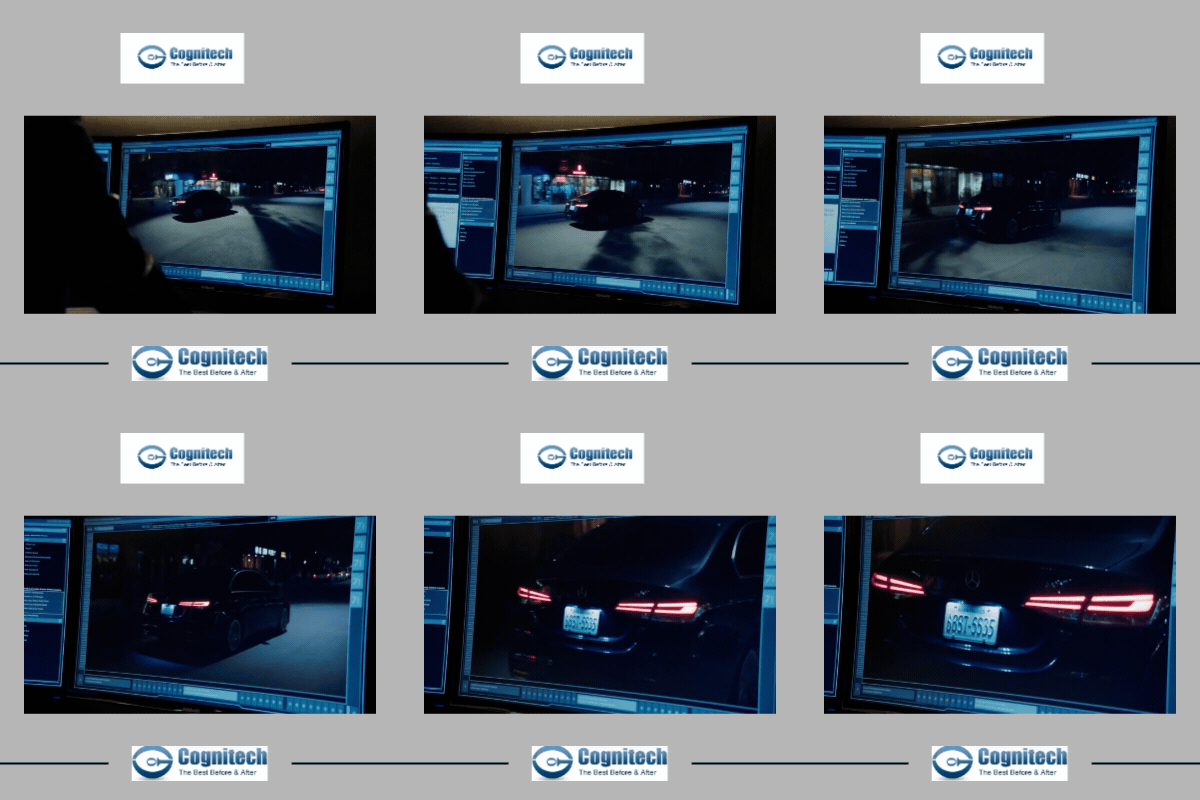
- Multi-frame reconstruction. If a vehicle passes through several frames, each frame may capture the plate at a slightly different position or moment. Combining that data can reveal detail no single frame contains on its own — similar in principle to how astronomers stack multiple exposures to reveal a clearer image of a faint object.
- Deblurring based on the actual motion path. If the blur follows a predictable pattern (say, a vehicle moving at a constant speed), that pattern can be used to computationally reverse some of the blur, recovering edges that were smeared but not lost.
- Geometric corrections. When a plate is captured at an angle, correcting the perspective can make the characters more legible without altering their actual shape or spacing. This relies on accurate camera calibration and lens correction, since the correction is only as reliable as the underlying model of how the camera distorted the scene.
- Noise reduction and contrast adjustment. Careful adjustment of contrast and reduction of sensor noise can make existing detail easier to see, without adding new information that wasn’t there.
- Frame-by-frame review. In many cases, no single frame is clear, but different frames each show a partial, readable piece of the plate. An analyst can document what each frame contributes rather than relying on one perfect result. Tools built for video upscaling and face enhancement work on this same principle pulling the clearest available signal out of imperfect source material.
Why the Process Matters as Much as the Result
In forensic work, a clear plate image is only useful if it can survive scrutiny. That means the process behind it needs to be documented and repeatable.
A defensible workflow typically includes:
- Working from the original, unaltered source file is never a copy that’s already been re-compressed or edited.
- Keeping a record of every step applied, so the process can be reproduced by another analyst.
- Avoiding any tool or filter that interpolates or “fills in” missing pixels based on assumptions rather than the source data.
- Being transparent about what the enhancement did and did not accomplish — including cases where a plate remains only partially readable.
This last point matters more than it might seem. A responsible enhancement report will sometimes say “characters 3 and 4 are not conclusively legible” rather than presenting a guess as a fact. That honesty is what gives the rest of the analysis credibility.
This is really an extension of good forensic video analysis practice generally the same standards of documentation and repeatability that apply to any piece of video evidence apply here too. And when a plate image ends at the center of a dispute, having a way to verify the file hasn’t been altered outside the documented process through forensic image authentication adds another layer of confidence to the result.
When a Plate Can’t Be Recovered
Not every case has a happy ending. If the original footage never captured enough real detail because the plate was too far away, too motion-blurred, or too heavily compressed, no amount of processing will make it legible. The information simply isn’t in the file.
In these situations, a competent forensic analyst will say so rather than push a low-confidence result. That’s a frustrating outcome for an investigation, but it’s the honest one, and it protects the integrity of whatever other evidence exists in the case.
This is also why camera placement and recording settings matter long before an incident happens. Higher resolution, adequate frame rate, and cameras positioned to capture vehicle approach angles all make a meaningful difference in whether a plate is recoverable later.
The unifying principle behind all of these methods: enhancement should reveal detail, not generate it. If a technique is filling in gaps with a best guess rather than recovering data, it has crossed from forensic analysis into something else and that distinction is exactly what a court or opposing expert will scrutinize.
What to Look for in Forensic Enhancement Software?
If you’re evaluating tools for this kind of work, a few things separate forensic-grade software from a general photo editor:
- Traceable processing history, so every adjustment can be reviewed and explained later.
- Non-destructive workflows, so the original file remains untouched and available for independent review.
- Frame-level control, rather than automatic, one-click filters that apply the same blanket adjustment across an entire clip.
- Support for a wide range of source formats, since surveillance systems rarely export in a standard, forensic-friendly format.
Cognitech’s video enhancement software is built around this kind of controlled, documented process designed for cases where the output needs to hold up under cross-examination, not just look sharper on a screen.
Conclusion
Improving license plate visibility in forensic video isn’t about making an image “clearer” in a generic sense; it’s about carefully recovering what the camera captured, through a process that can be explained and repeated. When that process is sounding, a nearly illegible plate can become the piece of evidence that identifies a vehicle. When the underlying footage simply doesn’t contain enough data, the honest answer is that no software can create what was never recorded. Either way, the value of the work comes from the rigor behind it, not just the final image.