
A grainy security clip doesn’t usually tell you much by itself. The lighting’s bad, frames get dropped, someone’s face is a blur of pixels, and half the timestamp on the file doesn’t even match what actually happened. Run that same clip through proper forensic video analysis, though, and it can turn into the piece of evidence that decides a case. That gap — between footage sitting on a hard drive and footage a prosecutor can actually use — is where these whole fields live, and it’s a lot more technical and procedural than most people assume until they’re actually involved in a case.
This piece goes through what the work looks like in practice, why raw footage almost never arrives courtroom-ready, the specific techniques examiners use to fix that, and a few things worth checking before you commit to forensic video analysis software for a lab or department.
What Forensic Video Analysis Actually Involves
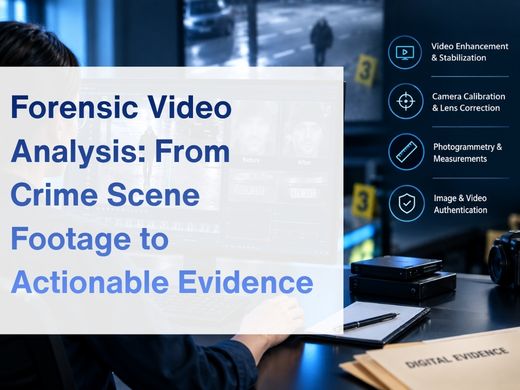
Put simply, forensic video analysis is examining and clarifying video so it can survive scrutiny — from an investigator, a defense team, a judge, whoever ends up looking at it. In practice that means clearing up footage too dark or blurry to make out, steadying shaky handheld or dashcam clips, checking a file for signs of tampering, pulling a usable still for identification, or figuring out real measurements — height, speed, distance — from whatever the camera happened to catch.
The thing that actually separates this from regular editing isn’t the software; it’s the paper trail. Every change an examiner makes gets written down, justified, and has to be repeatable — meaning someone else could take the same original file, follow the same steps, and land in the same place. That’s a fairly unforgiving standard, honestly, and it’s why nobody serious is doing this work in Premiere or Photoshop. Those tools were never built to survive being questioned in a courtroom.
Why Raw Crime Scene Footage Rarely Tells the Full Story
Most of the footage that ends up in an investigation wasn’t recorded with any of this in mind. It’s coming off a retail store’s DVR, a dashcam, a doorbell camera, somebody’s phone in bad light. Those systems exist to save on storage and keep half an eye on things — not to capture detail that’ll hold up months later in front of a jury. And that mismatch causes the same problems, over and over, case after case.
Compression is the big one. A lot of security systems record at low bitrates specifically to save disk space, and the second you zoom into a license plate or a face, you’re just looking at blocky noise. Lens distortion is another recurring headache — wide-angle security lenses bend everything near the edge of the frame, so any height or distance measurement is going to be off unless someone corrects that first. And then there’s just a bad light. Night footage, mixed indoor lighting, someone backlit by a window — it hides exactly the detail an investigator needs.
None of that gets solved by dragging a sharpness slider in a basic photo editor. That kind of fix tends to invent detail that was never actually there, and in a legal context, that’s not a shortcut — it’s the reason evidence gets thrown out. Actual forensic software works through these problems with controlled, documented methods that pull out what’s genuinely in the file instead of guessing.
The Core Techniques Behind Forensic Video Analysis Software
A few techniques come up over and over in this kind of work, and once you understand them, it’s pretty obvious why dedicated software exists instead of everyone just using whatever’s already on their laptop.
- Video enhancement and stabilization
Handle the compression, noise, and shaky-footage problems mentioned above — frame averaging, deinterlacing, contrast correction, motion stabilization, all logged step by step as it’s applied. Cognitech’s video enhancement software is built around this exact kind of controlled processing, rather than the trial-and-error you’d get out of a consumer tool.
- Camera calibration and lens correction
Matter whenever a measurement or identification depends on accurate geometry. Wide lenses warp everything near the frame’s edges, so before anyone can say anything about height or distance with confidence, that distortion must be mathematically corrected. Cognitech’s video forensic analysis platform builds calibration into the workflow itself instead of treating it as a separate step someone might forget.
- Photogrammetry
Sometimes just called forensic measurement, is how an examiner figures out real-world dimensions using reference points already sitting in the footage — how tall a suspect was, how far apart two cars ended up, how fast something was moving. It’s a genuinely specialized skill, and it’s the core of what crime scene video analysis tools are designed for.
- Image and video authentication
Asks a different question entirely: is this footage even real? Authentication work looks at compression artifacts, metadata, frame-by-frame continuity — trying to spot whether a clip’s been spliced or edited before it even reached the examiner. Given how often authenticity gets challenged these days, forensic image authentication has become just as central to casework as enhancement itself.
- Redaction, face enhancement, and upscaling
Matter more now than they used to, mostly because agencies are fielding public records requests alongside their actual investigations. Footage going public often needs bystanders blurred out while the person of interest stays clearly identifiable. Cognitech Intelligence’s data redaction and video upscaling tools are built around that exact balance, without messing with the underlying evidence file.
From Footage to Evidence: How the Process Works in Practice
The technical part is honestly only half of the job. Getting footage from a raw file to something usable in court is just as much about the process. It starts with securing the original — straight from the source device, if possible, because working off a copy of a copy degrades quality and can raise chain-of-custody questions later. From there, everything gets logged: what was done, in what order, with what software and version, and why.
Chain of custody must hold up from start to finish — a clear record of who touched the file, when, and what exactly they did. A lot of labs now handle cases spread across multiple locations, which is part of why digital forensics work has shifted toward centralized, cloud-based case management. It keeps things consistent even when several examiners are working in the same case from different offices.
Once the analysis is done, it gets written in a report — in plain language, since a judge or jury usually has no technical background to fall back on. If the case goes to trial, the examiner will likely have to testify and explain, in front of a room full of people who don’t do this for a living, why nothing about the process distorted or invented what the camera actually recorded.
Choosing Forensic Video Analysis Software: What to Look For
If you’re the one evaluating software for a lab or department, a clean interface is nice, but it’s not what matters most. What matters is whether the results hold up in court — every step logged, non-destructive, reproducible by a second examiner working from the same original. It also needs to handle messy, mismatched source footage, because most agencies aren’t dealing with one clean camera system — they’re dealing with a dozen different DVRs, codecs, and file types from a dozen different vendors.
Support and training end up mattering more here than in most software purchases, mainly because examiners get put on the stand and asked to explain how the tool works, not just what it produced. A platform with a real history in actual casework, decent documentation, and support that answers the phone tends to hold up a lot better under cross-examination than something chosen because the demo looked slick. It’s also worth figuring out whether you need standalone tools or a full forensic software suite — enhancement, measurement, authentication, case management, all in one place. That kind of integration saves real time once the caseload starts piling up.
Bringing It All Together
Forensic video analysis takes footage that would otherwise be dismissed as too unclear or too unreliable and turns it into something an investigation can stand on — but only when it’s handled with real methodology and the right tools behind it. The difference between footage that gets thrown out and footage that ends up deciding on a case almost always comes down to whether the process was documented, defensible, and built specifically for this kind of work.
If your team is building out or upgrading its forensic video capability, it’s worth a look at how Cognitech’s forensic video analysis software ties enhancement, measurement, authentication, and reporting together into one workflow, rather than stitching together a handful of separate tools that weren’t designed to talk to each other.
FAQ
- Can forensic video analysis “create” detail that wasn’t in the original footage?
No, and these trips people up a lot. Legitimate enhancement brings out detail already sitting in the data — it doesn’t add anything. AI upscaling that invents plausible-looking detail is generally avoided in evidentiary work for exactly this reason; it can end up misrepresenting what the camera actually caught. - How long does forensic video analysis usually take?
Depends heavily on footage quality, how many clips are involved, and whether measurement or authentication work is needed on top of enhancement. A single short clip might take a few hours. A multi-camera case can drag on for weeks. - Is enhanced video admissible in court?
Generally, if the process was documented, non-destructive, and reproducible, the analyst can explain their methodology clearly. Courts have accepted this kind of enhancement for decades under those conditions. What tends to get challenged is undocumented or unrepeatable work — not enhancement itself. - Do small police departments need dedicated forensic video software, or is outsourcing enough?
Both happen, and there’s no single right answer. Smaller departments often send anything complicated to an accredited lab or a contract examiner. Larger agencies with a steady flow of cases tend to bring capability in-house instead, since it’s usually cheaper over time.