
A photograph can be edited in seconds. Cropped, spliced, recompressed, or passed off as coming from a different device entirely and to the naked eye, none of it may show.
That’s the problem forensic examiners face constantly: an image looks fine, but “looks fine” isn’t evidence. What’s needed is a way to check the file against something that can’t be faked by eye and that’s where PRNU detection comes in.
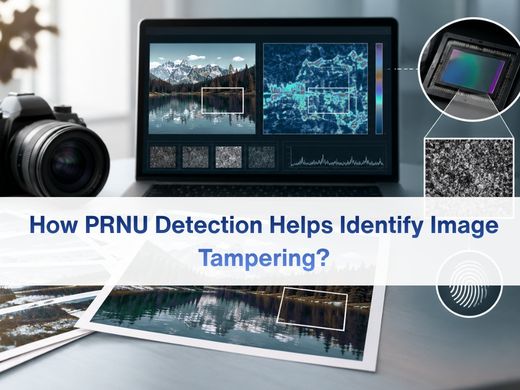
PRNU, short for Photo Response Non-Uniformity, is a technique that reads the tiny imperfections built into every camera sensor during manufacturing. Those imperfections form a pattern as unique as a fingerprint, and they show faintly in every photo the camera takes. If part of an image doesn’t carry that pattern or carries a different one that’s a signal something changed.
This article breaks down how PRNU detection actually works, what it can reliably tell you, where its limits are, and why it’s become a standard part of forensic image authentication workflows.
What Is PRNU, Exactly?
Every digital camera sensor is made up of millions of individual photo sites, each one converting light into an electrical signal. No two photo sites respond to light in exactly the same way — manufacturing at that scale introduces microscopic inconsistencies that no factory can fully eliminate.
Those inconsistencies form a fixed pattern of sensitivity across the sensor. It’s called Photo Response Non-Uniformity because different points on the sensor respond non-uniformly to the same amount of light. The pattern is:
- Sensor-specific — no two sensors, even from the same production batch, produce an identical pattern.
- Stable over time — it doesn’t meaningfully change with normal wear or age.
- Present in nearly every image — it’s embedded in the noise of every photo the sensor captures, whether the photographer notices it or not.
Because this pattern behaves like a physical signature, examiners can extract it from a set of known images and compare it against a questioned image to determine whether the same sensor produced both. It’s this principle that underpins most modern forensic image authentication software — using something physical and hard to fake as the baseline for a verification claim.
How PRNU Detection Works in Practice
The process generally follows a few core steps:
1. Building a reference pattern. Multiple images known to come from a specific camera are analyzed together. Averaging the actual scene content across those images’ leaves behind the sensor’s underlying noise pattern — the camera’s PRNU fingerprint.
2. Extracting noise from the questioned image. The image under examination is processed to isolate its own noise residual, separating it from the visual content itself.
3. Correlating the two patterns. The extracted noise from the questioned image is compared statistically against the reference fingerprint. A strong correlation suggests the same sensor captured both. A weak or absent correlation suggests otherwise — or points to a specific region within the image that doesn’t match.
4. Mapping consistency across the frame. Rather than treating an image as one solid block, correlation is often checked block by block. This is what makes PRNU useful for spotting localized tampering: if 95% of an image matches the reference pattern but one rectangular section doesn’t, that region likely came from somewhere else — a splice, an insert, or a region-specific edit.
What PRNU Detection Can Reveal
- Camera source verification. Given a suspect camera and a questioned image, PRNU analysis can help establish whether that specific device likely captured the image — useful when someone claims a photo was taken on a different device, or when the origin of an image is disputed.
- Localized splicing and composites. When one image is built from pieces of others, the PRNU pattern often breaks the seams. A correlation map can visually highlight the exact region where the pattern shifts, pointing directly to the manipulated area.
- Signs of re-saving or heavy processing. Repeated recompression, resizing, or filtering can degrade the PRNU signal in ways that differ from an untouched original, offering another data point on whether a file has been reprocessed since capture. The same logic extends to moving footage — forensic video analysis applies comparable frame-level consistency checks to spot re-encoded or altered video.

What PRNU Detection Cannot Do Alone
It’s worth being direct about the limits, because overstating forensic tools is exactly what undermines their credibility in court.
- It needs a reliable reference. Without a clean set of known-source images (or the original camera) to build the fingerprint, there’s nothing solid to compare against.
- Heavy compression can weaken the signal. Images that have been through multiple rounds of lossy compression — repeatedly saved as JPEG, shared across platforms, screenshotted — may carry a degraded pattern that’s harder to correlate with confidence.
- It doesn’t identify who made an edit or why. PRNU tells you whether a sensor pattern matches or where it breaks down. Interpreting that finding within the full context of a case still requires a trained examiner.
- Low correlation isn’t automatic proof of tampering. Other factors — sensor cleaning artifacts, extreme lighting conditions, or heavy in-camera processing — can also reduce correlation strength, which is why results are typically reported with statistical confidence, not as a binary yes/no.
This is precisely why PRNU is used as one component of forensic image authentication rather than a standalone verdict. Reliable image authentication workflows combine PRNU with error-level analysis, metadata review, compression-history checks, and visual inspection to build a complete, defensible picture.
Where PRNU Detection Is Actually Used
- Law enforcement and legal investigations — verifying whether evidentiary images originated from a claimed device or have been altered before being presented as evidence.
- Journalism and fact-checking — confirming whether an image circulating online matches its claimed source.
- Corporate and insurance investigations — checking whether photos submitted as documentation (accident scenes, damage claims) have been manipulated. When accident or damage evidence includes both stills and footage, video forensic analysis tools are often applied alongside image checks for a fuller picture.
- Digital forensics labs — as a standard technique within broader image and video authentication casework, frequently run through cloud forensics platforms that let multiple examiners collaborate on the same case files.
- Case-wide evidence review — where PRNU findings on individual images feed into a larger investigative picture managed through tools like Cognitech Intelligence.
A Practical Way to Think About It
If a fingerprint left at a scene doesn’t match a suspect, that tells you something — but it doesn’t tell you the whole story of what happened. PRNU works the same way. It’s a highly reliable way to ask “did this sensor produce this image, and does the whole image match consistently?” — and a weak or broken answer is a strong lead, not a final conclusion.
Examiners who treat it that way, and who pair it with corroborating checks, get results that hold up to scrutiny — from opposing counsel, from editors, or from anyone else with a reason to poke holes in the finding. This layered approach is the same one behind full-suite forensic video analysis software, where image authentication is one module among several working together.
Conclusion
PRNU detection works because it relies on something no editing tool can easily fake: the physical, manufacturing-level imperfections baked into a camera’s sensor. When used correctly — with a solid reference pattern and alongside other authentication methods — it’s one of the most dependable ways to verify whether an image is genuine or has been altered.
The technique isn’t a magic switch that labels a photo “real” or “fake.” It’s a precise measurement that, read by someone who understands its limits, adds real weight to an authentication finding. Tools built for forensic image authentication apply this kind of analysis systematically, so examiners aren’t relying on manual comparison alone.
FAQ
- Is PRNU detection reliable enough for court?
Yes, when applied properly with a solid reference pattern and reported alongside its statistical confidence. Courts generally expect it to be one part of a broader authentication process, not the sole basis for a conclusion. - Can PRNU detect edits made with AI tools?
It can often flag inconsistencies introduced by AI-generated or AI-edited regions, since those areas typically won’t carry the original sensor’s noise pattern. Results depend on how much of the image was altered and how heavily the file was compressed afterward. - Does PRNU work on images from phones, not just standalone cameras?
Yes. Any device with a digital image sensor — phones included — has its own PRNU pattern, though phone image pipelines apply more processing, which can affect signal strength. - What happens if there’s no reference camera available?
Examiners can sometimes build a reference pattern from a large set of other images confirmed to come from the same device, even without physical access to the camera itself. - Can PRNU tell you when an image was taken?
No. PRNU verifies sensor origin and internal consistency, not timing. Timestamp and metadata analysis are separate steps in a full authentication workflow.