
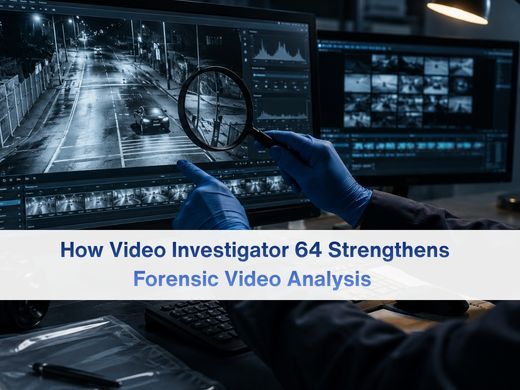
 The Rise of Digital Video Evidence
The shift to digital video has changed the way investigations are built. Almost every case now involves some form of visual evidence, captured continuously by surveillance systems, in-vehicle cameras, body cams, phones, drones, and fixed security stations. That’s a lot rawer material to work with, but it comes with real technical headaches. Footage is often compressed through proprietary encoding that makes it hard to work with across formats, and on top of that you’re dealing with low light, motion artifacts, interlacing issues, and bandwidth limits. The detail that actually matters in a case can easily stay buried — or get misread — if nobody processes it properly.
Why Forensic-Grade Tools Matter
This is exactly why investigators rely on forensic video analysis software rather than general-purpose editing tools. These systems are built to protect the integrity of evidence while giving analysts real visibility into what they’re looking at. That means controlled decoding, frame-by-frame inspection, precise pixel-level adjustments, and, critically, full preservation of metadata and processing history throughout. Every change has to leave a trail, so the analysis can be checked and reproduced later using the same digital forensics principles courts expect to see.
That’s really what separates forensic platforms from consumer editing software: they operate inside scientific and legal boundaries, not just creative ones. Original file formats stay protected chain-of-custody requirements are built in, and every analytical step gets logged. The rule is simple enhancement can clarify what’s already there, but it can never add something that wasn’t. Courts and independent experts depend on that boundary holding, since the results of this work often end up as evidence, backed by forensic video enhancement techniques designed specifically to stay within it.
Crime scene video analysis leans on these capabilities constantly, especially in complicated cases. Analysts need to be able to show, step by step, how raw footage was turned into usable evidence — nothing can be a black box. Forensic-grade tools exist to make that traceability possible, turning recordings that would otherwise need a lot of extra explanation into evidence that holds up on its own.
The Challenge of Raw Surveillance Footage
Most video evidence problems come down to a handful of recurring issues:
- Low-light conditions
- Motion blur
- Heavy compression artifacts
- Pixelation
- Subjects that are obscured or too far from the camera
Trying to interpret footage like this without the right tools is a good way to get it wrong. Professional-grade software applies scientifically validated image enhancement methods that improve clarity while leaving the original file data untouched.
Supporting Multiple Investigation Domains
Reliable forensic video tools aren’t just for traditional law enforcement anymore. They’re used across a much wider range of work, including:
- Public safety investigations
- Intelligence operations
- Border and security monitoring
- Accident reconstruction
- Internal corporate investigations
Across all of these, structured crime scene video analysis does the same job: it helps people interpret what actually happened on screen, instead of filling in the gaps with assumptions.
Scientific Approach to Digital Evidence
Good forensic work comes down to two things discipline and repeatability. The best tools bring together three functions that need to work as one system: enhancement, measurement, and documentation. At its core, that means putting data preservation first, applying scientifically sound processing methods, and keeping the whole process transparent enough to hold up to scrutiny something platforms like Cognitech Intelligence are built around, alongside capabilities like face enhancement and video upscaling.
Analysts doing crime scene video analysis have to be careful that enhancement never introduces something that wasn’t actually there. That’s why these systems rely on controlled algorithms and built-in validation checks — to make footage easier to interpret without taking on the risk of distorting it.
From Ambiguity to Actionable Insight
Good processing is often what separates an unclear piece of footage from one that actually holds up as evidence. A subject who’s barely visible can become identifiable. A disputed timeline can be confirmed. A confusing sequence of movement can be reconstructed logically enough to explain what happened.
Forensic video analysis software takes raw surveillance footage and turns it into organized, credible evidence the kind that stands up to scrutiny and holds together in court. Professional crime scene video analysis is built on technical methods that establish facts, not assumptions. It comes down to four connected pieces: enhancement, tracking, validation, and documentation all working together to give a clear, defensible read on what actually happened.
Final Thoughts
Video evidence isn’t optional in modern investigations anymore it’s become central to how cases get built. But its real value depends entirely on how well it’s processed. Consumer editing tools just aren’t built for this kind of work; professional environments need dedicated evidentiary tools that offer real structure, transparency, and analytical depth.
As the volume and complexity of digital evidence keep growing, law enforcement agencies and organizations need purpose-built systems they can actually rely on. The right tools take raw As the volume and complexity of digital evidence keep growing, law enforcement agencies and organizations need purpose-built systems they can actually rely on. The right tools take raw video and turn it into something closer to scientific truth evidence that holds up under examination and delivers when it matters most.
Full-Featured Applications in One Software Suite
Talk with experts for Forensic Video Processing Software and Forensic Image Processing Software solutions. Contact Cognitech! We hope you enjoyed this blog. Stay tuned for more, and follow us on Twitter, Facebook, Instagram, LinkedIn, or YouTube so you don’t miss our Community Blogs.
FAQs
- What is Forensic Video Analysis Software used for?
It performs scientific analysis of video evidence — enhancing and interpreting footage while keeping the original files untouched. It lets investigators examine individual frames, improve video quality, extract metadata, and build a traceable record of everything done, all for legal proof purposes. - How does forensic software differ from regular video editing tools?
Forensic platforms preserve original data structures, maintain chain-of-custody requirements, and document every step of the analysis. That’s what makes it possible to reproduce results reliably enough to use as evidence in judicial proceedings. - Why is documentation important in crime scene video analysis?
Because it keeps the process transparent. Experts need to be able to trace every enhancement or extraction back to its original source, especially under cross-examination. Proper logging is what protects the credibility of the findings. - Can forensic video software improve low-light or blurry footage?
Yes. Advanced tools apply structured noise reduction, contrast optimization, and motion correction to clarify footage all while preserving the evidentiary authenticity forensic work requires. - Is enhanced video evidence admissible in court?
It can be, when forensic experts process it through established validation protocols. Reliable forensic video analysis software supports that by offering reproducibility, documented workflows, and results an expert can explain and defend in court.