
A single photograph from a crime scene often holds more information than investigators realize. The height of a suspect caught on a store camera. The distance between a vehicle and a pedestrian at the moment of impact. The exact dimensions of a weapon left at the scene. None of this requires a tape measure — it requires photogrammetry.
For crime scene investigators, the challenge isn’t a lack of visual evidence. It’s turning that evidence into measurements that hold up under scrutiny. A blurry surveillance frame or an angled photo from a bystander’s phone can still yield precise, defensible data — but only with software built for forensic accuracy, not general photo editing.
This is where purpose-built photogrammetry software separates itself from consumer tools. It’s not about guessing dimensions from a picture. It’s about applying geometric calculation to known reference points so that measurements can be trusted in a report, a deposition, or a courtroom — the same standard that applies across a full forensic video analysis workflow.
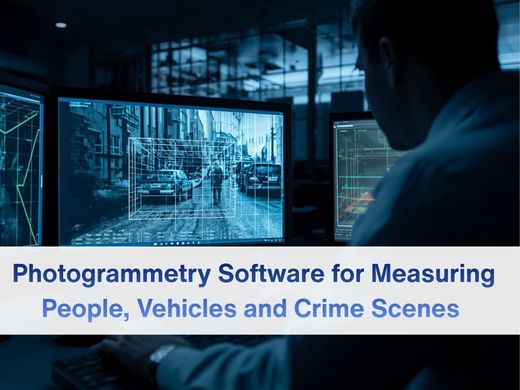
What Is Photogrammetry, and Why Does It Matter in Forensic Work
Photogrammetry is the science of extracting real-world measurements from photographs or videos. By analyzing the geometry of a scene — camera angle, lens characteristics, known reference objects, and vanishing points investigators can calculate distances, heights, and object sizes without ever physically visiting the scene with a measuring tool.
In forensic contexts, this matters because evidence often arrives after the fact. A crime is captured on a gas station camera, a doorbell camera, or a witness’s phone, and investigators are left working backward from static images to reconstruct what actually happened. Photogrammetry software fills that gap, turning two-dimensional images into reliable, three-dimensional measurements.
Where Photogrammetry Software Gets Used
- Measuring a person’s height from surveillance footage
When a suspect’s face isn’t clearly visible, height and build become key identifying details. Photogrammetry software calculates a person’s height by referencing fixed points in the frame — door frames, counters, or other objects of known dimension — and comparing them to the subject’s position in the image.
- Determining vehicle speed and position
In traffic collision investigations, photogrammetry can help establish where a vehicle was at a given moment, how far it traveled between frames, and its approximate speed, based on frame timing and scene geometry.
- Reconstructing crime scenes
Investigators can measure distances between objects, walls, and evidence markers directly from photos, which is especially useful when a scene has since been altered, cleared, or is no longer accessible. This kind of crime scene video analysis often works hand in hand with photogrammetric measurement to build a complete reconstruction.
- Verifying witness or suspect statements
If a statement claims a certain distance, angle, or line of sight was possible, photogrammetric analysis can confirm or challenge that claim using the actual image data.
How Photogrammetry Software Actually Calculates Measurements
Good forensic photogrammetry tools rely on a few core techniques:
- Reference-object calibration — using an object of known size within the frame (a doorway, a license plate, a floor tile) as a scale reference.
- Camera and lens correction — accounting for lens distortion, focal length, and angle so measurements aren’t skewed by the camera’s own optics. This is the same camera calibration and lens correction principle used in broader forensic video analysis.
- Vanishing point and perspective analysis — using the geometry of lines in the image (walls, floors, edges) to establish a consistent measurement grid across the scene.
- Single-image and multi-image methods — some cases only have one usable frame, while others allow cross-referencing multiple angles for higher confidence.
The output isn’t a rough estimate. When done correctly, it’s a measurement with a documented method behind it — which is exactly what’s needed when the result may be challenged in court.
What to Look for in Forensic-Grade Photogrammetry Software
Not all photogrammetry tools are built for evidentiary use. When evaluating software for crime scene or investigative work, a few factors matter more than flashy features:
- Court-defensible methodology The software should document how a measurement was derived — not just produce a number. Investigators need to be able to explain the calculation process if questioned during testimony.
- Compatibility with real-world footage Crime scene and surveillance footage is rarely clean. It’s compressed, low-resolution, poorly lit, or captured at odd angles. Software designed for forensic use should handle these conditions rather than requiring studio-quality input.
- Support for both images and video Since evidence frequently comes from video sources CCTV, dashcams, body cameras the ability to extract accurate frames and apply measurement tools directly to video is essential, not optional. Pairing measurement with proper video enhancement software also helps ensure the reference points used for calibration are actually visible and clear.
- Chain-of-custody friendly workflow Forensic software should support clear documentation and reporting, so findings can be handed off, reviewed, or presented without ambiguity about how they were produced.
- A track record in forensic and legal environments Software already trusted by law enforcement agencies and forensic labs carries a level of established credibility that generic measurement apps simply don’t have.
How Cognitech AutoMeasure Fits Into This Workflow
Cognitech AutoMeasure is built specifically for the kind of measurement work described above — calculating height, distance, and object dimensions from photographic and video evidence using photogrammetric methods. It’s designed to work within a forensic video analysis workflow, alongside tasks like image authentication software for verifying evidence integrity and video enhancement software for clarifying footage before measurement, so investigators aren’t switching between disconnected tools to build a complete case file. For agencies working across large volumes of footage, this can also connect into a cloud forensics setup for centralized case handling, or into broader Cognitech Intelligence tools for tasks like face enhancement and redaction.
For crime scene investigators and forensic analysts, the value isn’t just the calculation itself — it’s having a documented, repeatable process that produces measurements suitable for reports and legal proceedings.

Conclusion
Photographic and video evidence rarely comes with a ruler in frame — but that doesn’t mean the measurements aren’t there. Photogrammetry software gives crime scene investigators a reliable way to extract height, distance, and object dimensions from the visual evidence they already have, using methods that can be explained and defended when it matters most.
If your investigative work depends on turning images into measurable facts, the software behind that process should be built for forensic standards, not general photo editing.
FAQ
- What is forensic photogrammetry used for?
It’s used to calculate real-world measurements — such as a person’s height, an object’s size, or the distance between two points — directly from photographs or video, without needing physical access to the original scene. - Can photogrammetry software work with low-quality surveillance footage?
Forensic-grade tools are designed to handle the kinds of footage investigators actually encounter, including compressed, low-resolution, or poorly angled video, though accuracy improves with better-quality source material and clear reference points. - Is photogrammetric measurement accepted as evidence in court?
Measurements can be presented as evidence when the methodology is documented and defensible. Courts generally focus on whether the process used to derive the measurement is sound and repeatable, not just the final number. - Do you need multiple photos to calculate a measurement?
Not always. Single-image methods can work when a known reference object is visible in the frame, though multiple images or angles can increase confidence in the result. - How is this different from regular photo measurement apps?
Consumer measurement apps aren’t built to account for lens distortion, camera angle, or forensic documentation standards. Forensic photogrammetry software is designed specifically to produce measurements that can withstand scrutiny in an investigative or legal setting. - What kind of evidence works best for photogrammetric analysis?
Footage or images that include a visible object of known size — such as a doorway, floor tile, or license plate — tend to produce the most reliable measurements, since that object serves as the scale reference for the calculation.