
Segmentation and Video Enhancement Software in Investigations
Every frame of a video can hold a clue that breaks a case wide open, but only if you can actually see it. A tattoo on someone’s forearm, a partial plate number, a scar near the jawline; these details get lost all the time in footage that’s too dark, too grainy, or shot from too far away. That’s the whole reason video enhancement software exists. It takes footage nobody would trust as evidence and pulls out the parts that actually matter. Two filters do most of the heavy lifting here: Segmentation and Edge Detection. Between the two, forensic video analysis has gotten a lot more reliable.
What Segmentation Actually Does
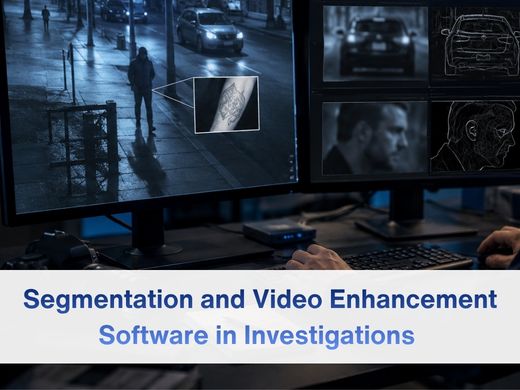
Segmentation splits an image into regions based on color and intensity. That’s the short version. In practice, it means a tattoo, a piece of clothing, or a scar can be pulled out from everything surrounding it in the frame, so an investigator isn’t stuck squinting at the whole picture trying to find the one detail that matters. It’s the same kind of precision you’d want out of image authentication software, where getting the details right isn’t optional.
Say you’ve got a suspect walking through a busy street on CCTV, and their sleeve rides up for maybe two seconds, just long enough to catch part of a tattoo. Without Segmentation, that’s gone the moment the frame changes. With it, that small region can be pulled out and enhanced on its own. Investigators reviewing hours of footage through cloud forensics setups run into this constantly, small windows of opportunity buried in long recordings.
What Edge Detection Actually Does
Segmentation handles regions. Edge Detection handles outlines. It traces the edges of objects in a frame, which ends up being the difference between a blurry vehicle and a readable license plate. This is a big part of why forensic video analysis has come so far in the last several years, it’s not just about brightening a video anymore.
A car crossing a dark parking lot at 2 a.m. usually looks like a lost cause. Run Edge Detection on it, though, and the plate number, the vehicle’s rough shape, even aftermarket modifications can start to show up. Combine that with proper enhancement and you’ve got something an investigator can actually put in a report, especially when it’s paired with measurement tools like photogrammetry software to nail down exact distances and sizes in the scene.
Why Any of This Matters
Footage almost never comes in clean. It’s dark, it’s blurry, it’s shot on a camera that’s ten years old. Forensic video analysis software exists to deal with exactly that, fixing brightness, cutting noise, sharpening what’s actually there instead of guessing it. The point isn’t a nicer-looking video. It’s whether that video can hold up as evidence. In a criminal case, that might mean identifying a suspect. In a crash investigation, it might mean showing which direction a car was actually moving before impact. Without enhancement, a lot of that just stays unreadable.
Putting Segmentation and Edge Detection Together
These two filters do better together than apart. Segmentation isolates the region worth caring about, an arm, a face, a section of a vehicle, and Edge Detection sharpens what’s inside it enough to compare against known references. Run one without the other and you’re leaving accuracy on the table, which is part of why both are built into suites like forensic video analysis tools that investigators already rely on.
It also just makes paperwork easier. A clean, sharpened image is something a judge or jury can look at and understand immediately; no explaining required. That matters more than people expect once a case actually goes to court.
How This Shows Up in Real Casework
Tools like Cognitech TriSuite64 get used on body cam footage, surveillance video, drone recordings, pretty much anything that comes across an investigator’s desk. Defense teams use the same kind of tools too, often through platforms like Cognitech Intelligence, so they’re not just taking someone else’s word for what the footage shows.
None of this is standing still, either. Machine learning is starting to sit alongside these older filters, helping segmentation and edge detection hold up even when conditions are rough, low light, crowded scenes, footage that’s just objectively bad. That’s steadily improving how far forensic image authentication methods can be pushed on the kind of evidence investigators actually deal with.
A Last Word
Reviewing footage used to mean watching it and hoping something would jump out. Now it means actually pulling detail out of frames that would’ve been written off a few years ago. Segmentation and Edge Detection are a big reason why, and paired with decent enhancement software, they turn footage nobody trusted into something that can hold up in an investigation or a courtroom.
None of this is optional anymore for teams that handle video evidence regularly. The tools exist, they work, and they catch details that would otherwise just get missed.
Talk with experts for Forensic video Processing Software and Forensic Image Processing Software solutions. Contact Cognitech! We hope you enjoyed this blog! Stay tuned, and don’t miss what’s coming next. Follow us on Twitter, Facebook, Instagram, LinkedIn, or YouTube, we post community blogs regularly, so you won’t miss a thing.
FAQs
- How does Edge Detection improve video evidence?
It traces the outlines of objects in a frame, so things like license plates, vehicle shapes, or facial contours that aren’t visible in the raw footage start to show up. - Why use Segmentation and Edge Detection together?
Segmentation picks out the part of the frame worth looking at, and Edge Detection sharpens it enough to compare or present. On their own, each does part of the job. Together, they cover it. - Can this software recover details from genuinely bad footage?
Usually, yes. Enhancement software deals with brightness, noise, and low resolution, and once Segmentation and Edge Detection get added in, footage that looked like a dead end can still turn up something useful. - What is video segmentation, exactly?
It’s splitting a frame into regions based on color and intensity, which lets investigators isolate a tattoo, a scar, or a specific piece of clothing instead of dealing with the whole image at once.