
How to Analyze Crime Scene Footage Without Physical Measurements
Let’s be honest, traditional crime scene investigation hasn’t always been efficient.
Investigators used to rely heavily on measuring tapes, on-site visits, and manual calculations. While that worked in the past, today’s reality is completely unique. By the time analysis begins, crime scenes often disappear, leaving only surveillance footage and a limited timeframe.
So the real question is:
How do you analyze crime scene footage accurately without ever stepping onto the scene?
That’s where modern photogrammetry and crime scene video analysis come in. Once you understand how it works, it almost feels like having a virtual measuring tool inside the video itself.
Let’s break it down in a practical, simple way.
Why Physical Measurements Are No Longer Necessary
Think about a typical case. You have CCTV footage of a suspect. The scene has already changed. Maybe objects have been moved, or the location is no longer accessible.
In the past, this would be a major limitation.
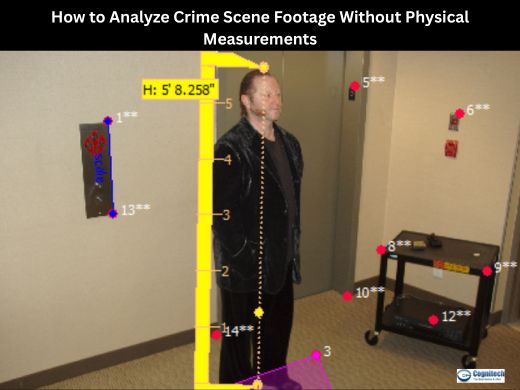
But with forensic photogrammetry, you can extract measurements directly from images and videos without needing the physical scene at all.
Modern tools like Cognitech AutoMeasure 64 allow investigators to
- Measure a suspect’s height
- Calculate distances between objects
- Analyze angles, areas, and trajectories
- Reconstruct entire crime scenes digitally
And the key part is simple. No measuring tape. No guesswork.
In fact, this type of software can compute accurate biometric and scene measurements directly from surveillance footage and images.
Step 1: Start with the Right Footage
Even though you don’t need physical measurements, you still need usable footage.
Here’s what helps:
- Clear frames, even if not perfect
- Multiple angles if available
- Visible reference points like walls, doors, or objects
The good news is that modern tools for analyzing crime scene videos don’t require perfect footage. They are built to handle real-world conditions like
- Low-resolution CCTV
- Moving cameras
- Partial obstructions
This approach works because the analysis is not just visual. It is mathematical.
Step 2: Use Photogrammetry to Turn Images into Measurements
At its core, photogrammetry is about extracting real-world measurements from images.
Instead of physically measuring a scene, the software analyzes:
- Camera perspective
- Geometry of the scene
- Matching points across frames
With advanced systems, this process becomes automatic.
Rather than estimating distances, the system calculates them using spatial relationships inside the footage. This makes the results far more reliable.
Step 3: Automatic Camera Calibration
One of the biggest challenges in video analysis is understanding the camera itself.
Questions like:
- What is the angle?
- What is the focal length?
- Is there distortion?
Traditionally, this required manual work. Now, modern tools handle it automatically.
Automatic camera calibration helps:
- Detect distortion
- Understand camera settings
- Align footage with real-world measurements
This step ensures your measurements are accurate and not just visually convincing.
Step 4: Extract Measurements from a Single Frame
Here is something many people do not expect.
You can extract measurements from just one frame.
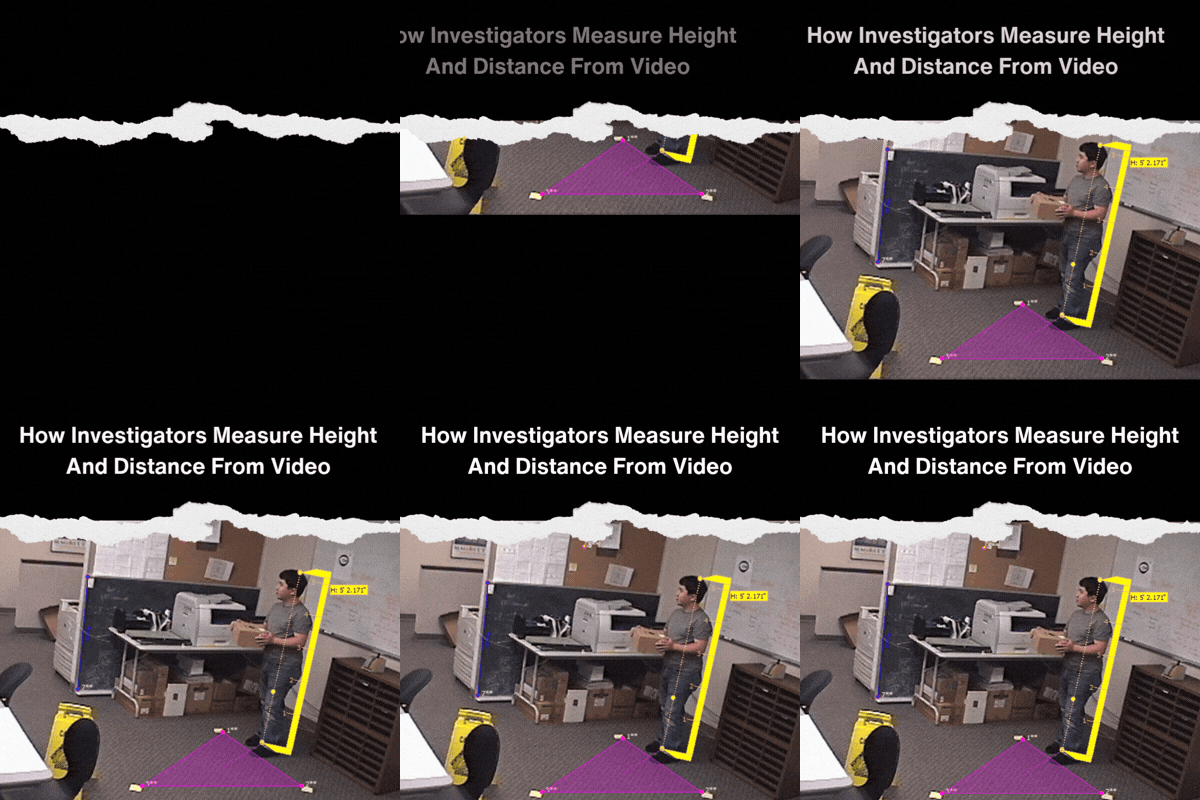
With single-frame metrology, investigators can:
- Measure a suspect’s height
- Estimate object size
- Calculate distances
Even if you only have one usable image, you can still get meaningful data from it.
Step 5: Use Multi-View Analysis for Better Accuracy
If you have multiple frames or images, the accuracy improves even more.
MultiView photogrammetry allows you to:
- Combine different perspectives
- Improve measurement precision
- Analyze larger areas
Instead of relying on one angle, the system builds a more complete understanding of the scene.
This helps with:
- Distance measurements
- Area calculations
- Object dimensions
Step 6: Reconstruct the Scene in 360 Degrees
This is where things become really powerful.
Modern crime scene video analysis tools can create a full 360-degree reconstruction of the scene.
This allows you to:
- Explore the scene virtually
- Measure from different viewpoints
- Analyze areas not visible in a single frame
Even if something is hidden in one image, another frame can help fill in the missing information.
Step 7: Analyze Without Visiting the Scene
This is the real advantage.
With advanced photogrammetry software, you can:
- Work remotely
- Revisit the scene anytime
- Extract new measurements whenever needed
Even if the physical crime scene no longer exists, you can still perform accurate analysis using saved footage.
Step 8: Reduce Errors and Save Time
Manual measurement methods often lead to the following:
- Human error
- Inconsistent results
- Time delays
Automated forensic photogrammetry helps solve these problems by:
- Providing guided workflows
- Offering real-time feedback
- Ensuring consistent results
Because everything is digital, your results are repeatable, reliable, and ready for legal use.
What This Means for Investigators
This shift changes how investigations are done.
Instead of depending on physical access, investigators can now:
- Analyze scenes remotely
- Extract precise data from videos.
- Reconstruct events with confidence
It makes the process faster, more accurate, and far more efficient.
Final Thoughts
If you think about it, this evolution makes sense.
We live in a world full of cameras. CCTV, smartphones, and dashcams constantly capture valuable evidence. The challenge is turning that footage into usable data.
That is exactly what photogrammetry and crime scene video analysis are designed to do.
With tools like Cognitech AutoMeasure 64, the process becomes practical, accurate, and scalable.
Talk with experts for Forensic video Processing Software and Forensic Image Processing Software solutions. Contact Cognitech! We hope you enjoyed this Blog! Stay tuned, and don’t miss the coming blogs. You can follow us on Twitter, Facebook, Instagram, Linkedin, or Youtube: we post Community Blogs regularly so you won’t miss any!
FAQs
- What is forensic photogrammetry?
Forensic photogrammetry is a way to get measurements from pictures or videos to look at crime scenes and evidence. This helps people figure out what happened. - Can you measure height from CCTV footage?
Yes, investigators can use techniques called photogrammetry to guess how tall someone is, from security camera videos. - How accurate is crime scene video analysis?
If people use the tools and set them up correctly crime scene video analysis can give very accurate results that people can trust. - What are the benefits of automated photogrammetry software?
Automated photogrammetry software is helpful because it reduces mistakes, saves time, and lets investigators do measurements without having to do a lot of math by hand. This makes forensic photogrammetry easier and faster.