
Camera Calibration in Forensic Photogrammetry Explained
When you think about forensic video analysis, you probably imagine enhancing a blurry video or zooming in on crucial evidence. But behind all those clear reconstructions and accurate measurements is something less visible but absolutely vital: camera calibration. It is one of those technical steps that sounds complicated but is really about one thing: making sure what you see in the image actually reflects what exists in the real world.
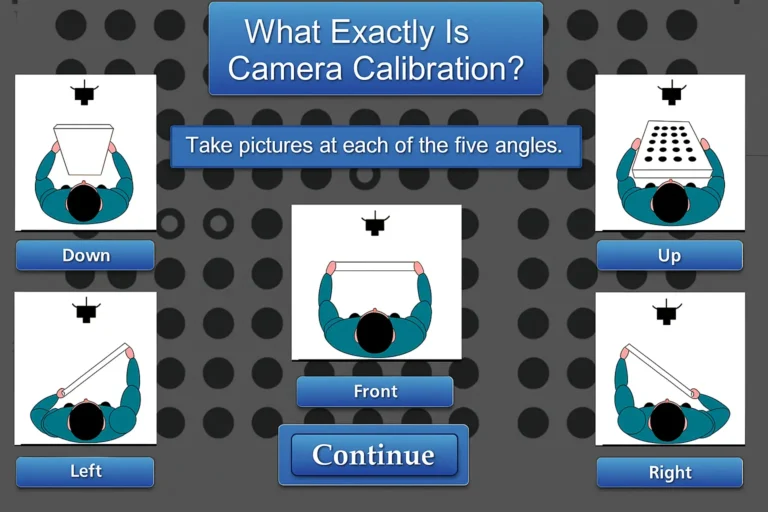
So, What Exactly Is Camera Calibration?
In simple terms, camera calibration is the process of figuring out how a camera sees the world. Every camera, whether it is a bodycam, security camera, or smartphone, captures images through a lens that slightly distorts reality. Straight lines can look curved, objects might appear closer or farther than they actually are, and angles can be misleading. For everyday photos, that distortion is no big deal. But in forensics, where a single millimeter or degree can change the story, it matters a lot.
Calibration defines the mathematical relationship between the camera and the 3D world. By understanding that relationship, forensic analysts can measure real-world dimensions like heights, vehicle distances, body proportions, and angles, all from images or videos. Without proper calibration, those measurements would be educated guesses at best.
Why It Matters in Forensic Photogrammetry
Forensic photogrammetry is all about extracting reliable measurements and 3D reconstructions from imagery. Think of it like turning flat pictures into evidence-based 3D scenes. But if the camera that captured the scene was not properly calibrated, your reconstruction could be off, and in forensic work, close enough does not cut it.
That is where Cognitech AutoMeasure comes in. As part of the Cognitech VideoActive® 64 software suite, AutoMeasure is designed specifically for forensic use, where precision and repeatability are critical. It is not just about measuring a suspect’s height or estimating the size of a vehicle. AutoMeasure can calculate almost any measurable element in the visible crime scene, such as angles, distances, areas, and even biometric details like shoulder width.
Cognitech Automatic Camera Calibration: A Game Changer
Traditional camera calibration methods often rely on manual steps like placing a test pattern in front of the lens, measuring distances by hand, and hoping the camera did not slightly shift. That is time-consuming, prone to human error, and not always practical when working with real-world video evidence.
Cognitech completely reimagined that process with its patented Automatic Camera Calibration. The system uses an intelligent test pattern recognition method to detect calibration patterns automatically in test images. Once identified, the software removes lens distortion and accurately estimates internal camera parameters such as focal length and optical center deviation. In simpler terms, it corrects the image so what you measure is what is truly there, not what the camera “thought” it saw.
The result is more accurate, faster, and repeatable measurements that investigators can confidently present in court.
New Improvements That Make a Real Difference
Cognitech continues to push the boundaries of accuracy and efficiency. The latest version of its camera calibration tool includes two major upgrades that make a noticeable impact.
First, there is an improved calibration algorithm that delivers even higher precision. It may sound like a small tweak, but in photogrammetry, small improvements multiply. Better calibration means better reconstructions, which means stronger, more defensible evidence.
Second, Cognitech has introduced a stand-alone calibration program that is easier to use and more intuitive. It displays the calibration pattern directly on the screen, reducing common issues like warping or stretching that can throw off results. This improvement makes the process more accessible to forensic professionals who might not have a technical background but still require top-tier accuracy.
From Pixels to Proof
What truly sets Cognitech apart is how seamlessly its technology fits into real-world forensic workflows. Investigators and analysts do not have time for complex manual setups. They need software that is intelligent, reliable, and built for evidence-based work. With AutoMeasure and Automatic Camera Calibration, that is exactly what they get.
When you can trust that your measurements reflect reality, every step that follows, from analysis to 3D reconstruction to expert testimony, becomes stronger. In an industry where evidence accuracy can make or break a case, that level of precision is invaluable.
In short, camera calibration might not be the most glamorous part of forensic photogrammetry, but it is the foundation that makes accurate visual evidence possible. And with Cognitech’s innovative approach, the science behind the lens is now more precise than ever.
Advanced Camera Calibration and Lens Correction
FAQs
- What is camera calibration in forensic photogrammetry?
Camera calibration is the process of determining how a camera captures the real world. It corrects lens distortion and defines the relationship between the camera and the 3D environment to ensure precise measurements. - Why is camera calibration important for forensic analysis?
Accurate calibration ensures that measurements taken from images or videos truly reflect real-world dimensions, making reconstructions and evidence analysis scientifically reliable. - How does Cognitech’s Automatic Camera Calibration work?
Cognitech’s patented system automatically detects a calibration pattern in test images, removes lens distortion, and calculates internal camera parameters for unmatched measurement accuracy. - What makes Cognitech AutoMeasure stand out?
Cognitech AutoMeasure can measure not only height but also angles, areas, vehicle dimensions, and body proportions. Combined with automatic calibration, it offers a complete forensic measurement solution.