
What Every Crime Scene Investigator Needs to Know About Video Analysis
In the world of criminal investigations, precision is paramount. Modern technology has revolutionized how law enforcement professionals gather, analyze, and interpret evidence. Among the most significant advancements is the use of forensic video analysis in investigative workflows. This sophisticated approach enables every crime scene investigator to piece together events with unparalleled accuracy, ensuring that justice is served. Let’s delve into the role this technology plays in modern investigations, its techniques, and its truly transformative impact on the field.

What Is Crime Scene Video Analysis?
Crime scene video analysis refers to the process of examining, enhancing, and interpreting video evidence captured at or near a crime scene. This evidence can come from a wide variety of sources, including:
- Surveillance cameras
- Police body-worn cameras
- Dash Cams
- Mobile devices
By carefully analyzing these video recordings, forensic experts can uncover critical details that might otherwise go unnoticed, such as identifying suspects, establishing the sequence of events, or verifying whether witness accounts hold up under scrutiny.
Why is Video Analysis Crucial in Modern Investigations?
Video evidence is often referred to as an unbiased witness. Unlike human recollection, which can be flawed, emotionally colored, or deliberately manipulated, video recordings provide an objective account of events as they actually happened. Here is why this form of analysis has become indispensable in today’s investigations:
- Accuracy and Reliability: Video footage captures precise details of events, offering reliable evidence that can withstand rigorous scrutiny in a court of law.
- Corroborating Testimonies: By cross-referencing video evidence with witness statements, investigators can validate or refute claims with a degree of confidence that simply wasn’t possible before.
- Identifying Suspects and Evidence: Advanced video analysis tools can sharpen blurry footage and zoom into specific areas, making it possible to identify suspects, vehicles, or key objects.
- Timelines and Event Reconstruction: Video footage helps establish a clear, verifiable timeline of events, giving investigators a comprehensive picture of exactly what is transpired.
Techniques Used in Crime Scene Video Analysis
Modern forensic video investigation combines traditional detective work with cutting-edge technology. What follows is a closer look at the key techniques that a skilled crime scene investigator relies on today.
1. Video Enhancement
Often, raw video footage is of poor quality due to low lighting, motion blur, or obstructions. Video enhancement involves using software to improve clarity, adjust brightness and contrast, stabilize shaky footage, and zoom in on specific areas without losing detail.
What many people don’t realize is that modern enhancement tools can go beyond basic adjustments — combining data from multiple frames to reconstruct sharper imagery than any single frame alone could provide. Cognitech’s Video Investigator 64 integrates this directly with photogrammetry workflows, so enhanced footage can flow straight into measurement pipelines without any additional steps, keeping evidence both accurate and court admissible.
2. Frame-by-Frame Analysis
This technique involves meticulously examining each frame of the video to identify key moments, capture fleeting details, and detect inconsistencies or tampering.
It’s especially valuable in fast-moving events — a physical altercation, a hit-and-run, or a split-second exchange — where critical actions are invisible at normal playback speed. Stepping through footage frame by frame gives a crime scene investigator the ability to pinpoint exactly when and how an event unfolded, building a precise, defensible account of the sequence of events.
3. 3D Reconstruction and Photogrammetry Software
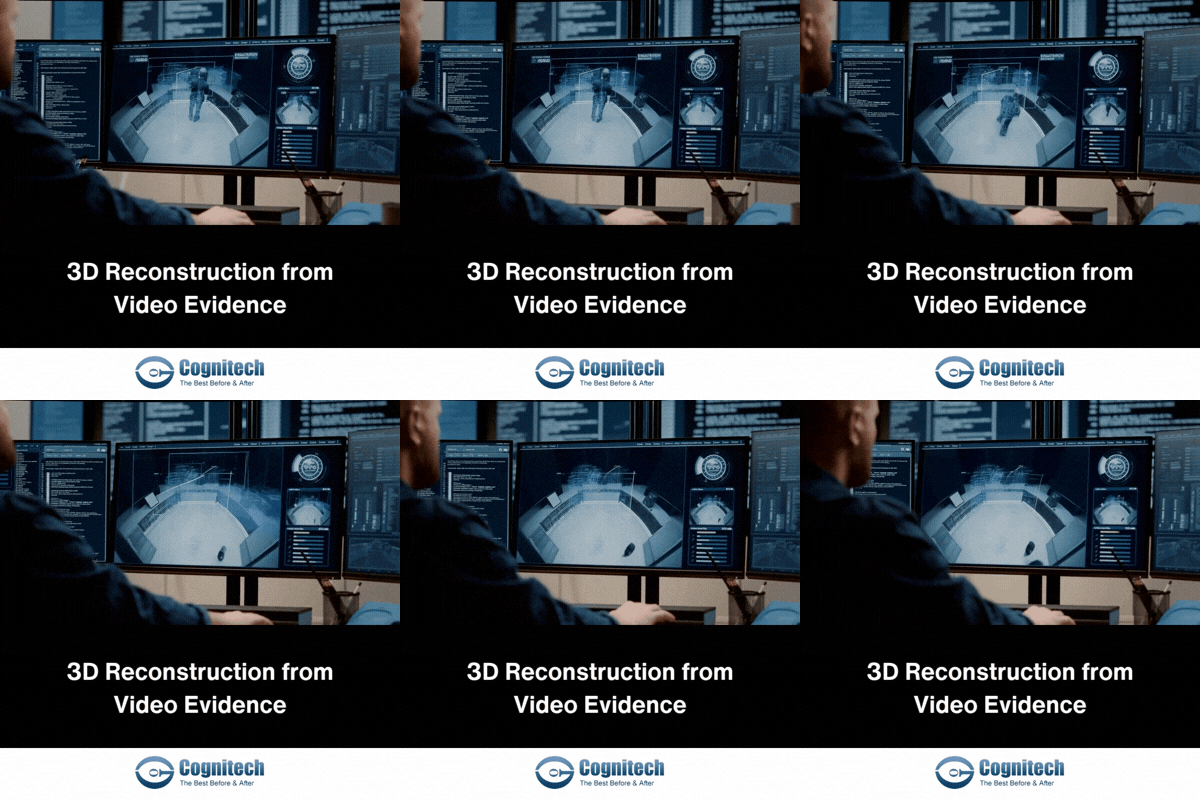
Using video footage, forensic experts can create 3D models of the crime scene. This helps visualize the sequence of events, analyze spatial relationships, and present compelling evidence in court. Cognitech AutoMeasure 64 — the world’s first automatic Photogrammetry Software for forensic use — takes this further by extracting precise biometric and spatial measurements directly from video and photos. It can calculate height, area, distances, vehicle dimensions, and angles without requiring a measuring tape or even access to the original scene. This is particularly powerful when a scene no longer physically exists, as stored images and calibration parameters are all the software needs to produce legally sound measurements.
4. Facial Recognition and Object Detection
Advanced algorithms can scan video footage for matching faces with known databases and identifying objects such as weapons or vehicles.
These tools significantly reduce the time it takes to process large volumes of footage, automatically flagging persons or items of interest rather than relying entirely on manual review. Cognitech’s AI-driven recognition capabilities are built to work alongside its enhancement and Photogrammetry Software tools, so once a suspect or vehicle is identified, investigators can immediately move into precise measurement and scene reconstruction without switching platforms.
Applications of Forensic Video Analysis
The versatility of modern forensic video analysis makes it invaluable across a wide range of investigations.
Homicide and Violent Crimes
Video analysis can capture crucial moments leading up to and following a crime, providing evidence of intent or premeditation.
In violent crime cases, photogrammetric measurements taken from surveillance footage can help corroborate or contradict a suspect’s account — for example, by accurately determining the height and build of an attacker from camera footage, or by establishing exact positions of individuals at the moment a crime occurred. This kind of precise, spatially grounded evidence carries significant weight in court.
Property Crimes
Surveillance footage is often key in identifying perpetrators of burglaries or thefts.
Even when footage quality is poor, video enhancement tools can recover usable details from low-light or low-resolution recordings. Combined with photogrammetric height measurements, investigators can often confirm whether a suspect’s physical profile matches the figure captured on camera — turning what seemed like inconclusive footage into solid, actionable evidence.
Traffic Accidents
Dashcam and surveillance footage aid in reconstructing accidents to determine fault or assess liability.
Modern photogrammetry tools allow investigators to extract exact vehicle positions, speeds, and impact angles directly from that footage — even after the physical scene has been cleared. This means an accurate reconstruction can be produced days or weeks later, using nothing more than the recorded video and calibrated camera data, which is invaluable when physical evidence is no longer available.
Fraud and Cybercrimes
Analyzing digital video evidence can uncover fraudulent activities or identify suspects in cyber-related crimes.
Security footage from ATMs, bank branches, and corporate facilities can place suspects at the scene of unauthorized transactions or data breaches. In cases involving staged accidents or fabricated insurance claims, video analysis can definitively show that the physical details of a claimed incident don’t match what the footage actually recorded — exposing deception that would be very difficult to prove by any other means.
How Cognitech Enhances Modern Investigations
At Cognitech, we specialize in providing state-of-the-art tools and solutions for video analysis. Our proprietary software offers advanced capabilities such as real-time video enhancement, AI-driven facial and object recognition, and 3D crime scene reconstruction using industry-leading photogrammetry software.
These tools empower law enforcement agencies to uncover hidden details, streamline investigations, and present compelling evidence in court. Every solution in the Cognitech TriSuite 64 package is designed to work seamlessly together, meaning a crime scene investigator can move fluidly from enhancement to measurement to reconstruction within a single, integrated workflow.
Conclusion
Forensic video analysis is transforming the landscape of modern investigations. By leveraging advanced technology, investigators can uncover truths with unparalleled precision, ensuring justice is served. At Cognitech, we are proud to be at the forefront of this revolution, equipping professionals with the tools they need to solve mysteries and protect communities. As technology continues to evolve, so too will the potential of forensic video investigation, promising even greater accuracy and efficiency in the fight against crime.
Talk with experts for Forensic Video Processing Software and Forensic Image Processing Software solutions. Contact Cognitech! We hope you enjoyed this Blog! Stay tuned, and don’t miss the coming blogs. You can follow us on Twitter, Facebook, Instagram, Linkedln, or Youtube: we post Community Blogs regularly so you won’t miss any!
FAQs
Q1. Can video enhancement make blurry surveillance footage usable in court?
Yeah, in many cases it can. Modern tools can reconstruct detail from multiple frames, and the result comes out forensically sound, court-admissible footage. Stuff like Cognitech’s Video Investigator 64 makes sure the enhanced material still lines up with legal expectations, even if the original recording was meh.
Q2. How does a crime scene investigator measure a suspect’s height from video?
They typically use photogrammetry software, like Cognitech AutoMeasure 64, and then the investigator estimates height and biometric dimensions right from the footage itself. This still works even when the original camera has been moved or, worse, removed from the location.
Q3. What happens when there is no physical crime scene left to investigate?
Honestly, sometimes there isn’t any physical scene to even look at anymore. Modern forensic tools don’t always require the actual location—photogrammetry software can rebuild measurements from stored images and video alone, producing results that are ready for court long after the scene no longer exists.
Q4. Is frame-by-frame video analysis only useful for violent crimes?
Not at all. It’s helpful for property crimes too, plus traffic accidents, insurance, or fraud cases. Basically, it turns footage that seems ordinary at normal speed into a very precise, moment by moment narrative of what happened.
Q5. How reliable is facial recognition in real criminal investigations?
It’s a powerful starting point, not a final answer. Its flags match quickly, but human verification always follows. Combined with video enhancement and photogrammetry, the overall identification becomes significantly more reliable and defensible.