
How Forensic Experts Use Surveillance Enhancement Tools
When it comes to solving crimes, surveillance footage often plays the role of a silent witness. But let’s be honest, most raw footage isn’t exactly clear. It’s grainy, shaky, overexposed, or captured from a poor angle. That’s where forensic experts step in, armed with specialized surveillance video enhancement software designed to uncover critical details hidden in plain sight. Companies like Cognitech, Inc. have turned this process into a science, offering tools that help investigators turn ordinary footage into actionable evidence.
Let’s break down how these experts actually use the technology, with a clear look at how digital evidence turns into justice.
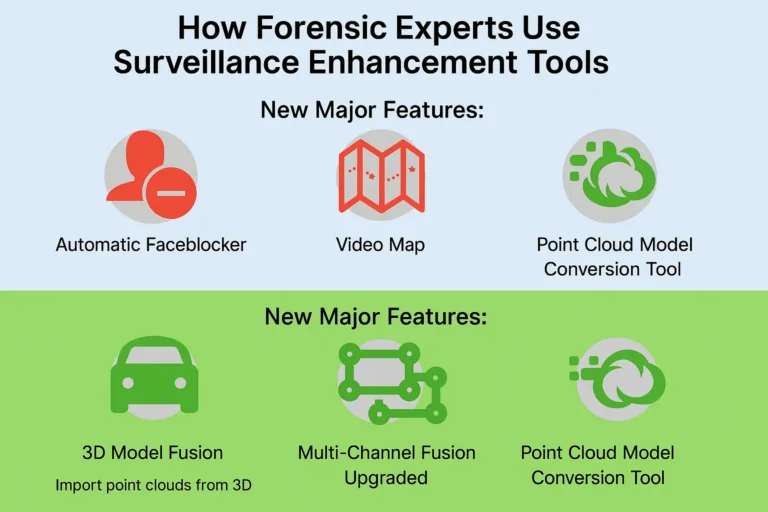
1. Clearing the Noise: Automatic Faceblocker
Sometimes, investigators deal with footage that can’t be released publicly without protecting the identities of innocent bystanders. Normally, this kind of video redaction can take hours or even days of tedious, frame-by-frame blurring. That’s where Automatic Faceblocker steps in.
It automatically detects and blocks faces in a video, letting analysts blur sensitive footage in minutes. This means police departments or agencies can safely release video to the public while keeping privacy intact. It’s a simple idea, but it saves countless hours and ensures ethical video handling, something that matters deeply in real-world investigations.
2. Reconstructing Movement: Video Map
Imagine a suspect walking through a city block captured by ten different security cameras. Each camera sees only part of the story. Forensic experts use Video Map to bring all those pieces together.
By placing camera locations directly on a Google street map and syncing each one with its corresponding footage, investigators can trace movement from camera to camera. It’s like watching a digital breadcrumb trail unfold in real time. Instead of flipping between separate videos, analysts can visualize how someone moved across locations, turning scattered clips into a cohesive narrative of events.
This isn’t just convenient; it’s powerful evidence in court, especially when timelines or sequences are disputed.

3. Protecting Evidence Integrity: File Hashing
One of the biggest challenges in digital forensics is proving that video evidence hasn’t been tampered with. Enter File Hashing.
When experts process a video, this tool generates a unique “hash key” for that file, a digital fingerprint that confirms authenticity. If even a single pixel changes, the hash changes too. So, whether the footage is analyzed today or five years from now, investigators can prove it’s the same, untouched piece of evidence.
For forensic experts, this kind of transparency builds credibility in court and reinforces public trust in digital investigations.
4. Merging the Real and the Digital: 3D Model Fusion
Now we’re getting into some seriously advanced territory. With 3D Model Fusion, forensic analysts can import point clouds from 3D scanners and align them with video or image evidence.
Here’s why that matters: imagine you’ve got surveillance footage of a getaway car. With Cognitech’s patented 2D Video to 3D Scan Model Matching technology, experts can match the vehicle’s shape and dimensions to 3D models to confirm (or rule out) its make and model.
It’s like CSI, but in real life and with verifiable math behind it. The precision of this process helps eliminate guesswork and supports conclusions with measurable data.
Ready to Enhance Your Surveillance Footage?
5. Seeing from Every Angle: Multi-Channel Fusion
In most cases, one camera doesn’t capture the whole story. That’s why forensic experts use Multi-Channel Fusion, a tool that combines video from multiple viewpoints.
With perspective correction and frame-accurate playback, the upgraded version lets experts align and synchronize different clips, fusing them into a single, unified view. It’s incredibly useful for reconstructing complex events like accidents, robberies, or crowd incidents.
Think of it as building a 3D puzzle from multiple flat images. When done right, it gives investigators the ability to see what actually happened from every possible angle.
6. Converting Data for Deep Analysis: Point Cloud Model Conversion Tool
Raw 3D data isn’t always easy to work with. The Point Cloud Model Conversion Tool solves that by converting formats like .XYZ and .WRL into Cognitech’s 3D-compatible structure.
This may sound technical, but it’s vital for forensic workflows. It ensures compatibility across Cognitech’s ecosystem, so tools like Multi-Channel Fusion and 3D Model Fusion can operate seamlessly together. Essentially, it bridges the gap between data capture and deep forensic analysis.
Bringing It All Together
Forensic experts don’t just enhance video; they analyze, verify, and contextualize it. With tools like Cognitech’s TriSuite64, they can uncover the smallest detail in a surveillance clip, confirm the authenticity of evidence, and even reconstruct entire events in 3D space.
What makes this technology so fascinating is how it blends art and science: the art of observation with the science of digital precision. Every clarified frame, every reconstructed angle, helps bring clarity to what really happened.
In the end, these forensic tools aren’t just about making a video look clearer; they’re about revealing the truth hidden in pixels, helping investigators see what the human eye might have missed, and ensuring that justice is guided by undeniable, measurable evidence.
Talk with experts for Forensic video Processing Software and Forensic Image Processing Software solutions. Contact Cognitech! We hope you enjoyed this Blog! Stay tuned, and don’t miss the coming blogs. You can follow us on Twitter, Facebook, Instagram, Linkedin, or Youtube: we post Community Blogs regularly so you won’t miss any!
FAQs
- What is surveillance video enhancement software used for?
Surveillance video enhancement software is used to clarify, analyze, and authenticate video footage for investigative or forensic purposes. It helps reveal important details like faces, vehicle plates, or movements that may not be visible in raw video. - How do forensic experts verify that video evidence hasn’t been altered?
They use file hashing technology, which generates a unique digital fingerprint for each video. Any change in the file would alter this fingerprint, confirming whether or not the footage has been tampered with. - Can video from multiple cameras be combined for better analysis?
Yes. Tools like Multi-Channel Fusion allow experts to merge video from multiple viewpoints, synchronizing frames to create a unified, accurate reconstruction of events. - What makes Cognitech forensic tools unique?
Cognitech’s software suite stands out for its patented 2D-to-3D model matching technology, real-time enhancement capabilities, and integrated ecosystem that supports both visual analysis and precise measurement in a forensic workflow.