
How Image Enhancement Improves Forensic Evidence
If you have ever tried to zoom in on a grainy security photo and thought, “There has to be more here,” you are not wrong. In forensic work, images almost never arrive in perfect condition. They are blurry, dark, compressed, or shot from incorrect angles. That is where image enhancement earns its keep and why it matters so much in modern investigations.
But here is the real talk. Enhancement alone is not enough. You also need image authentication software to make sure what you are looking at has not been tampered with. That combo, enhancement plus authentication, is what turns a questionable image into solid forensic evidence.
Why Raw Images Are Rarely Good Enough
Most forensic images come from CCTV systems, smartphones, dashcams, or body cams. These devices prioritize storage and speed, not image quality. So you end up with:
- Motion blur
- Low resolution
- Harsh lighting or deep shadows
- Compression artifacts
- Missing or damaged metadata
To the naked eye, that can make key details like faces, license plates, objects, and timestamps basically useless. Image enhancement helps bring those details back into focus in a controlled, scientifically sound way.
What Image Enhancement Actually Does In Forensics
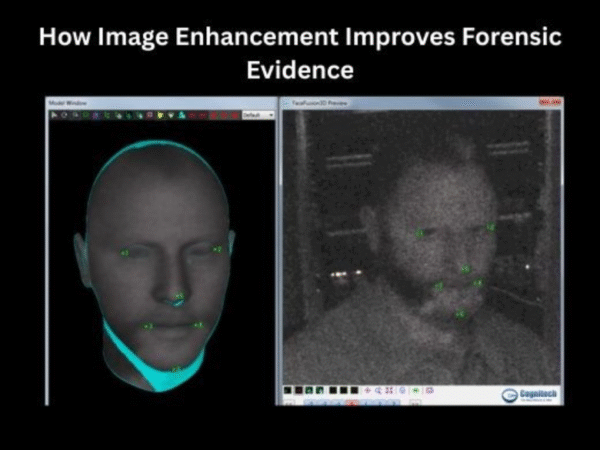
This is not general editing software, and it is definitely not about filters or “making it look nicer.” Forensic image enhancement is about clarity without distortion. The goal is to reveal what is already there, not invent new details.
Some of the most useful enhancement techniques include:
- Contrast and brightness correction to pull detail out of dark or washed-out areas
- Noise reduction to clean up grainy footage
- Sharpening to define edges and fine features
- Zooming and resampling to examine small areas more closely
- Frame averaging in video to stabilize and clarify moving objects
When done right, enhancement can make the difference between “we cannot tell what this is” and “we can clearly identify that object or person.”
Why Enhancement Alone Is Not Enough
Here is the hard truth. Enhanced images are useless in court if you cannot prove they have not been tampered with.
That is where image authentication software comes in. It validates the integrity of the file and checks for signs of manipulation, things like cloning, splicing, recompression, or metadata edits.
Without authentication, an opposing attorney can easily argue that your enhanced image was altered in a misleading way. And once doubt is planted, your evidence loses weight fast.
How FIA Bridges the Gap Between Clarity and Credibility
FiA is built specifically for forensic analysis and authentication of digital images. It combines image enhancement with serious image authentication software capabilities in one forensic-grade toolkit.
FiA allows the user to:
- Investigate evidence at the pixel level
• Detectpossible traces of tampering or manipulation
• Systematically identify forged or doctored digital images
• Authenticate files using a forensic scientific methodology
• Document every step for court-ready reporting
In other words, FIA does not just make images clearer. It makes them defensible.
Enhancing a shadowed face not only improves visibility but also demonstrates that no one spliced that face into the image later. This is the benchmark for forensic work.
From Blurry Footage to Courtroom-ready Evidence
Let us say you are working with low-quality CCTV footage from a convenience store robbery. The suspect’s face is barely visible, and the lighting is awful.
Using image enhancement, you can:
- Stabilize shaky frames
- Increase contrast to reveal facial features
- Reduce noise from low-light conditions
- Isolate key frames where the face is most visible
Then, using image authentication software like FiA, you can:
- Verify that the footage hasnot been edited
- Detect compression or recompression artifacts
- Check for frame insertion or deletion
- Generate a forensic report showing your full process
Now you are not just saying, “Here is a clearer image.”
You are saying, “Here is a scientifically validated, authenticated forensic image.”
That distinction matters.
Make your digital evidence courtroom ready.
Enhance, authenticate, and verify images using FiA’s forensic image enhancement and image authentication software.
Click HereBottom line
Image enhancement is powerful, but only when it is done the right way.
On its own, enhancement helps investigators see what is hidden in low-quality images. Paired with image authentication software, it becomes something much more valuable: trustworthy forensic evidence that can stand up in court.
FIA brings both sides together. It enhances images, detects tampering, authenticates digital files, and produces court-ready reports based on solid forensic science.
In a world where fake images are getting easier to create by the day, that kind of credibility is not optional anymore. It is essential.
Talk with experts for Forensic video Processing Software and Forensic Image Processing Software solutions. Contact Cognitech! We hope you enjoyed this Blog! Stay tuned, and don’t miss the coming blogs. You can follow us on Twitter, Facebook, Instagram, Linkedin, or Youtube: we post Community Blogs regularly so you won’t miss any!
FAQs
- What is image enhancement in forensic investigations?
Image enhancement in forensics is the scientific process of improving clarity in digital images without altering the original content. It helps reveal hidden details like faces, license plates, or objects in low-quality images while keeping the evidence intact and court-admissible.
- Why do I need image authentication software along with enhancement?
Image enhancement alone does not prove image authenticity. Image authentication software checks file integrity, detects manipulation, and confirms that enhanced images remain true to the original evidence.
- Can image enhancement be used as legal evidence in court?
Yes, when done correctly. Courts accept enhanced images if the process is scientifically sound and fully documented. Tools like FiA combine image enhancement with image authentication software to produce court-ready forensic reports.
- What makesFiAdifferent from regular forensic tools?
FiA is a comprehensive forensic solution that combines image enhancement and image authentication software in one platform. It detects forged or doctored images, identifies tampering, follows forensic scientific methodology, and generates official court-ready reports.