
How Noise Reduction Impacts Forensic Video Enhancement
When it comes to forensic video analysis, clarity is everything. A single frame can hold the key to identifying a suspect, confirming a timeline, or validating an alibi. But in reality, most surveillance footage isn’t perfect. It’s grainy, full of compression artifacts, and often shot under poor lighting or weather conditions. That’s where noise reduction comes in. It’s not just a technical process; it’s a bridge between raw, distorted footage and usable, court-admissible evidence.
In forensic video enhancement, noise refers to the unwanted visual disturbances that cloud the true image, such as pixel-level randomness, sensor noise from low-quality cameras, or interference from environmental factors. The tricky part is cleaning the image without removing the details that matter most, like facial features, license plates, or subtle hand movements. That’s why noise reduction isn’t about making videos look pretty. It’s about preserving truth while removing distraction.
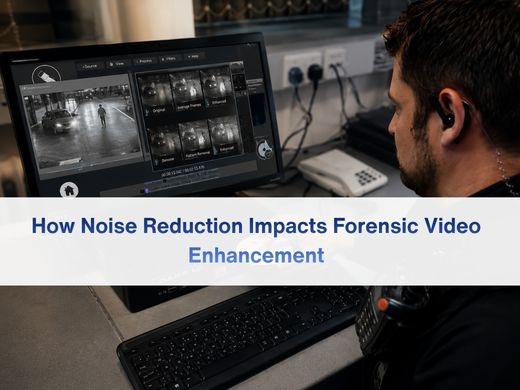
The Balance Between Clarity and Authenticity
When forensic analysts enhance video, they walk a fine line. Go too far, and you risk introducing artifacts or altering details that could be critical in court. Do too little, and the video remains too distorted to be useful. The goal is precision, reducing the clutter without changing the content.
This is where a large assortment of denoise filters comes into play. These filters offer both traditional and advanced approaches to minimize noise without sacrificing clarity or important image features. Each one serves a slightly different purpose, depending on the condition of the video and the type of noise present. For instance, footage captured from an old CCTV camera might need a completely different treatment compared to a body-worn camera recording at night.
Average Frames: Finding Stability in Motion
One of the most reliable techniques in forensic video enhancement is the Average Frames filter. This filter works by combining multiple frames of a video sequence to generate a single, cleaner image. Imagine stacking several transparent layers of the same frame. The random noise patterns cancel each other out, while the consistent details, like a person’s face or a vehicle, remain clear.
This approach is especially useful when dealing with stationary objects in a video. If a surveillance camera captures a parked car in a dimly lit alley, each frame might look slightly different because of sensor noise. The Average Frames filter removes that flickering effect, leaving a more accurate and stable representation. The result is a clearer image without artificial smoothness or blur.
Pattern Removal: The Subtle Science of Cleaning Surfaces
Another powerful tool is the Pattern Removal filter, an advanced method for eliminating pattern noise from images. This type of noise is often tricky because it’s repetitive, blending into textures or surfaces. In forensic contexts, that might mean faint grid-like patterns from sensors, interference in a recording, or textured surfaces like walls or fabric backgrounds.
This filter is particularly valuable when analyzing latent prints or evidence on textured materials. For example, if an investigator photographs a fingerprint left on a patterned countertop, the pattern can make it hard to distinguish the actual ridges of the print. The Pattern Removal filter isolates and removes those background patterns, allowing forensic experts to focus on the true evidence.
Real-World Impact in Forensic Investigations
In law enforcement and defense applications, noise reduction doesn’t just make things look better, it directly affects the accuracy of investigations. Enhanced clarity can reveal identifying features that were completely invisible in the original footage. It can help confirm or disprove a timeline of events, verify the authenticity of evidence, and ensure the findings are scientifically valid.
Tools like Cognitech TriSuite64 make these processes faster and more precise. Analysts can choose from a range of real-time filters, test multiple enhancement techniques, and preview results instantly, ensuring the final output maintains evidentiary integrity. This kind of control and transparency is what separates true forensic enhancement from generic video editing.
Preserving the Evidence, Not Changing It
Every forensic analyst knows that authenticity is non-negotiable. Courts demand verifiable methods and documented enhancement steps. That’s why advanced denoise filters in forensic software are designed to be non-destructive and fully reversible. Each step is recorded and traceable, so investigators can prove exactly how an image was processed.
The ultimate goal isn’t perfection, it’s reliability. The best enhancement is the one that helps the truth stand out naturally, without artificial manipulation.
In Closing
Noise reduction in forensic video enhancement isn’t just about technology, it’s about responsibility. Every filter, every adjustment, and every pixel matters when the outcome could influence justice. With advanced tools like the Average Frames and Pattern Removal filters, forensic experts can reveal the hidden details that make or break a case, all while preserving the integrity of the original evidence.
Because in this field, clarity isn’t cosmetic. It’s critical.
Talk with experts for Forensic video Processing Software and Forensic Image Processing Software solutions. Contact Cognitech! We hope you enjoyed this Blog! Stay tuned, and don’t miss the coming blogs. You can follow us on Twitter, Facebook, Instagram, Linkedin, or Youtube: we post Community Blogs regularly so you won’t miss any!
FAQs
- What is noise reduction in forensic video enhancement?
Noise reduction is the process of removing unwanted visual interference from video footage, helping forensic analysts reveal important details more clearly. - Why is noise reduction important in surveillance footage?
Most surveillance videos are low quality due to lighting or compression. Noise reduction improves clarity, making crucial evidence visible for analysis or court. - What types of filters are used for noise reduction?
Common filters include the Average Frames filter for reducing dynamic noise and the Pattern Removal filter for cleaning textured or patterned surfaces. - Does noise reduction alter the authenticity of evidence?
No. When done using forensic-grade tools like Cognitech TriSuite64, noise reduction is fully documented, reversible, and maintains the original data integrity.