
Photogrammetry Software in Digital Forensics: A Modern Guide for Crime Scene Investigators
Digital investigations have changed because of digital evidence which has become crucial for law enforcement agencies. Investigators use modern surveillance systems, which include cameras and smartphones, and body cameras to obtain critical incident evidence through their recorded videos and images. The complete situation requires more than just base materials because proper measurements and scene restoration are necessary to establish what occurred. The essential function of Photogrammetry Software becomes clear when forensic experts rely on it for their work.
Understanding Photogrammetry in Forensic Investigations
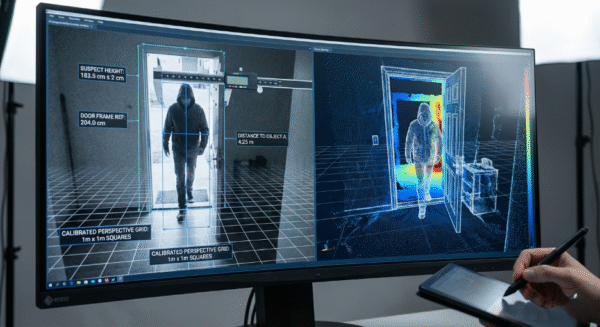
Photogrammetry serves as a scientific method which extracts actual measurements from photographic images and video recordings. Forensic scientists use this method to create crime scene reconstructions while they measure suspect size for distance calculations between two items in a photograph. The crime scene investigator uses this technology to examine evidence when he cannot reach the physical location anymore.
Sophisticated forensic equipment enables users to establish suspect height measurements while they identify vehicle dimensions and track movement paths throughout the entire location. Investigators receive these capabilities for their investigations because the system provides them with unbiased data which they can present in court to reinforce their legal arguments through quantifiable proof.
How Forensic Photogrammetry Software Works
Modern Photogrammetry Software obtains its measurement framework through reference points established within its image processing system. The system calculates accurate dimensions by detecting objects which include doors and vehicles and furniture. Some tools can resolve camera distortions while they determine the camera position for precise three-dimensional scene reconstruction.
The multi-view photogrammetry system uses multiple images to generate its most precise measurement results. Forensic teams use this method to recreate entire crime scenes while they measure items which appear in multiple frames with different angles.
Key Benefits for Crime Scene Investigators
For crime scene investigators, the ability to measure evidence from remote locations transforms their work processes. Investigators need to conduct physical measurements at the crime scene which proves impossible for some situations. digital photogrammetry tools permit measurements beyond scene clearing because they work with stored images or videos to make measurements.
Biometric measurement serves as another benefit for investigators. From the surveillance footage, investigators can determine the suspect’s height and shoulder width and other body measurements. Investigators use these biometric characteristics to identify or exclude suspects from the investigation process.
Forensic photogrammetry tools create court-ready reports that contain visual overlays and measurement annotations, and technical documentation. The presentation of findings for legal proceedings occurs through this method which shows all results to the courtroom audience in a clear and official manner.

Advanced Features in Modern Photogrammetry Tools
The leading forensic solutions use automatic camera calibration to eliminate lens distortion while the system calculates internal camera parameters for precise measurements. The process enhances system performance through accuracy improvements while it decreases the likelihood of human errors occurring during operations.
Investigators can measure objects from single images through single-frame measurement and from multiple images through multi-view measurement. The reconstruction of extensive scenes requires multi-view methods which achieve better dimensions but requires precise measurements to function properly in complex investigations.
Some platforms let users do 360-degree scene reconstruction which enables them to explore a crime scene virtually while they take measurements from all directions. The immersive process enables forensic teams and attorneys and jury members to grasp how evidence exists in space.
Practical Applications in Real Investigations
Photogrammetry Software finds use in real-world situations through its capability to study robbery evidence and traffic accident data and violent crime investigation results. Investigators use measurement techniques to determine distances between suspects and victims while they track bullet paths and study blood spatter distribution. The measurements provide investigators with factual evidence which supports their case conclusions.
The technology enables crime scene investigators to finish their tasks quicker while using fewer resources. Analysts can conduct precise measurements through digital platforms without needing to visit actual sites. The process preserves all evidence while it decreases logistical issues because evidence needs to be kept in its original state.
Accuracy and Reliability in Forensic Photogrammetry
Forensic science depends on accuracy which modern Photogrammetry Software works to achieve through its design as an error-reducing system. The system uses automated error feedback to help users fix their point of placement mistakes which enhances measurement accuracy. Photogrammetry results reach their maximum accuracy potential when users employ appropriate calibration and multiple reference points.
Forensic experts need to recognize all technological constraints which exist within their field. The measurement accuracy suffers when image quality drops and the camera angle changes and lighting conditions differ. Defensible results require employees to receive training in proper methodology usage.
The Future of Photogrammetry in Forensic Science
Photogrammetry tools have become more powerful and accessible because of digital imaging technology progress. Forensic analysis capabilities grow through video enhancement software and 3D reconstruction platform integration with forensic analysis systems. Forensic teams now possess the ability to digitally recreate complete crime scenes with precise object measurement abilities while they deliver results through immersive 3D presentation methods.
Photogrammetry technology implementation serves as an important step toward data-driven investigations for all crime scene investigators. The combination of visual evidence and accurate measurements helps forensic professionals discover hidden details which would remain unknown without this process.
Conclusion
The progress of digital forensics now depends on measurement-based analysis, which has become essential for current investigative procedures. Investigators use Photogrammetry Software to obtain precise measurements which they use to recreate scenes and establish their case through scientific proof. The ongoing development of forensic technology will ensure that photogrammetry serves as a vital resource for crime scene investigators who need to achieve precise results and effective work methods and trustworthy outcomes.
Talk with experts for Forensic video Processing Software and Forensic Image Processing Software solutions. Contact Cognitech! We hope you enjoyed this Blog! Stay tuned, and don’t miss the coming blogs. You can follow us on Twitter, Facebook, Instagram, Linkedin, or Youtube: we post Community Blogs regularly so you won’t miss any!
FAQs
- What is photogrammetrysoftwareforensics?
Photogrammetry software is used to extract accurate measurements from images or videos, helping investigators analyze crime scenes digitally. - How does a crime scene investigator use photogrammetry?
A crime scene investigator uses it to measure distances, estimate suspect height, reconstruct scenes, and analyze spatial relationships in evidence. - Is photogrammetryaccuratefor legal cases?
Yes, when calibrated properly and supported with reference points, photogrammetry provides scientifically defensible measurements suitable for court. - Can photogrammetry work with surveillance footage?
Yes, it can analyze CCTV or smartphone footage to measure objects and reconstruct events, even after the physical scene is unavailable.