
Why Clone Fusion Matters in Forensic Image Analysis
When you look at a photo, it usually feels simple. You see a scene, a moment, or an object. But in forensic work, photos are more than that. They are pieces of evidence. And if even a tiny part of that image has been copied, pasted, or altered, the truth can get twisted fast.
That is where Clone Fusion comes in. It is a powerful tool inside Cognitech’s FiA 64, a forensic image analysis software designed to find hidden copy and paste edits inside a single image. And trust me, the way it works is pretty amazing once you break it down.
What Is Clone Fusion?
Clone Fusion is an automatic tool that searches for “clones.”
But what does that mean?
A clone is when someone copies part of an image and pastes it somewhere else in the same image. You see this a lot when someone wants to cover something up or smooth out an area.
For example:
- Erasing a person from the background
- Covering a weapon
- Removing a shadow
- Filling empty space so the edit looks natural
To the human eye, these edits can look perfect. But the pixels don’t lie. Clone Fusion looks for repeating patterns that do not belong. Even if those repeated areas are rotated, resized, or lightly blurred, the software can still flag them.
Why Clone Detection Even Matters
You might wonder why such tiny edits are a big deal.
Well, in forensic cases, small edits can change everything.
Imagine a crime scene photo where a key object was removed. Or a piece of evidence was covered by cloning grass, sky, or flooring from another part of the picture. That small edit could mislead investigators, lawyers, or even a jury.
This is why image authentication software is so important today. With editing tools becoming easier and more advanced, you need something even smarter to catch manipulation. Clone Fusion helps ensure that evidence stays honest.
How Clone Fusion Works Inside FiA 64
Cognitech’s FiA 64 is built for deep forensic image analysis. It does not just look at the picture. It studies the structure of the image at a pixel level.
Here is the simple version of how Clone Fusion works:
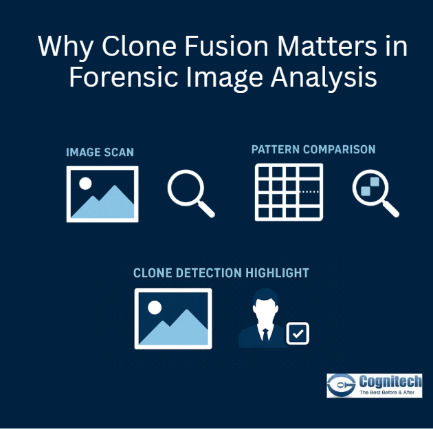
- The software scans the entire image
It breaks the image into small blocks so it can compare them to each other.
- It looks for repeated pixel groups
If two parts of the image share the same structure or texture, that is a clue.
- It tests rotated and resized patterns
This is important. Many forgers rotate cloned areas to hide the copy/paste. FiA 64 still catches it.
- It highlights the suspicious regions
The software shows both the source area and the cloned area, so the analyst can compare them side by side.
- The analyst confirms the result
FiA 64 provides the visual evidence, but a trained expert interprets the findings.
The combination of automation and expert review makes this process strong enough for court use.
Clone Fusion vs. Normal Editing Detection
There are many ways to edit an image. Some leave big clues. Some leave tiny ones. Clone detection focuses on one of the most common tricks: the copy/move method.
Other tools inside image authentication software look at things like:
- JPEG artifacts
- Noise inconsistencies
- Metadata changes
- Color channel patterns
Clone Fusion works right alongside these tools. Think of them as different layers of truth checking. If something slips past one tool, another one might catch it. When all these tools agree, the analyst can trust the results.
Why FiA 64 Is Trusted in Forensic Work
Cognitech’s FiA 64 has been used for years by law enforcement, forensic labs, and government agencies. The software is built for people who handle digital evidence every day. It is not a simple editing app. It is a serious forensic toolkit.
A few reasons why experts rely on it:
- It gives highly detailed visual outputs
- It supports court-ready reporting
- It detects even small manipulations
- It provides multiple verification layers
- It requires real training, which keeps the process professional
Clone Fusion is only one feature of many. But it is one of the features that makes FiA 64 so effective at spotting hidden edits.
Real World Situations Where Clone Fusion Helps
Here are common cases where clone detection becomes important:
Crime scene photos- Someone might try to hide blood stains, footprints, or objects by cloning parts of the floor or wall.
Surveillance images- Edited footage may clone background elements to hide a person or vehicle.
Why Clone Fusion Matters Today
We live in a world filled with editing tools. Anyone can edit a photo from their phone in seconds. This makes forensic work harder. But it also makes Clone Fusion more important than ever.
It helps protect the truth.
It catches manipulation that the human eye might miss.
And most important, it gives forensic teams a reliable way to verify digital evidence.
When the stakes are high, accuracy matters. Cognitech’s FiA 64 and its Clone Fusion tool help give investigators that accuracy.
Talk with experts for Forensic video Processing Software and Forensic Image Processing Software solutions. Contact Cognitech! We hope you enjoyed this Blog! Stay tuned, and don’t miss the coming blogs. You can follow us on Twitter, Facebook, Instagram, Linkedin, or Youtube: we post Community Blogs regularly so you won’t miss any!
FAQs
- What is Clone Fusion in forensic image analysis?
Clone Fusion is a tool inCognitech’s FiA 64 that detects copy and paste edits inside an image. It finds repeated pixel patterns that may indicate tampering. - Howdoes Clone Fusion detect cloned areas?
The tool scans the image, compares pixel blocks, and highlights regions that match too closely. It also checks rotated or resized patterns to catch hidden edits. - Why is clone detection important in digital evidence?
Copy and paste edits can hide objects or alter scenes. Clone detection helps ensure photos used in investigations are real, untouched, and reliable. - IsCognitech’sFiA 64 suitable for court use?
Yes. FiA 64 is professional image authentication software designed for forensic analysts, law enforcement, and agencies needing court-ready results.